
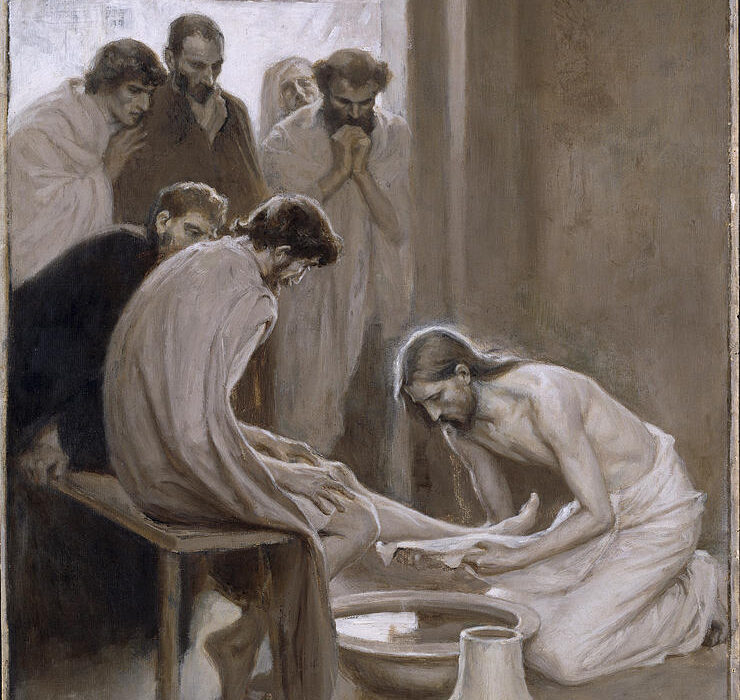
Maundy Thursday
‘All that the LORD has spoken we will do, and we will be obedient.’
+INJ+
Thus spoke the people of Israel before Moses when he had delivered to them the rules and counsels and commands of the Divine Law. ‘We will be obedient.’
It should have been obvious, even to them, that that was a promise they would not keep. ‘Obedience’ is not a drive common to man. We teach children to obey, yet they never seem to learn. We bring them to imitate something like obedience through a creative and elaborate system of bribes, punishments, fear, psycho-social manipulation, and yelling. These are children, who when they are born do not know that they have feet, much less can they walk, yet before they can properly pronounce the letter ‘R’ can already tie their shoes.
But obedience for its own sake, to hear what is spoken to them, and to hold it to their hearts as a dear word and order, a sacred pledge; this they cannot. Nor do we, though we think we are grown.
Our Lord now gathers with the disciples to eat the Passover. He is soon to institute the Most Holy Eucharist, the Communion of His Body and Blood. Yet we first read that Jesus is about to accuse one of them of plotting to betray Him.
But before this, something interesting happens, something that confuses the Twelve.
The disciples have gathered together, and they did that what came most natural to them, they argued amongst themselves about who was the greatest.
It is then that it is written in the Gospel of John that Jesus laid aside his outer garments, and taking a towel, tied it around his waist. Then he poured water into a basin and began to wash the disciples’ feet and to wipe them with the towel that was wrapped around him.
The one that they believe to be the promised the Messiah, the heir of King David, now takes the form of a servant, a slave. He strips Himself to the point of nakedness, and shakes the dust off the feet of the disciples.
St. Peter rebukes the Lord: Peter said to him, “You shall never wash my feet.”
It was of course customary for a house-slave to wash the feet of the guests of the master. Yet none of them apparently volunteered for the task. Such is an action done by the least. But they argue about who was the greatest.
Yet in the midst of this discussion, Peter is offended that the Lord would strip Himself to wash them. They all argued about who was the greatest amongst the Twelve, but all would agree that the greatest among them all was Jesus.
But Jesus does exactly as He should.
As the Son of God, He does exactly as God should, who sends the rain upon the just and the unjust alike. As the Son of God, He is perfect like His Father in heaven.
And as the Son of Man, He does not merely pour Himself out upon the disciples in this work of humiliation, but does so in His Body, revealing the nakedness of His human form, and He does it to cleanse the bodies of those He serves.
Ultimately, the disciples do not understand Jesus, because they do not understand God. It is the way of God to create the world out of nothing. It is the way of God to give to that which cannot give back, for the Lord of the Universe has nothing to gain from that which He has made.
Many of the Israelites believed that in exchange for the gift of existence, it was their duty to offer sacrifices to God. Yet such was never the purpose of sacrifice, for God takes no delight in the blood of bulls and goats. The sacrifices of the Old Covenant were to serve as a training of the soul, and of the eyes, that when God would give that which was from eternity His own, they might be able to recognize it. They believed that in offering pure sacrifices, they would serve God. But the sacrifices were commanded that by them the people might see how God will finally serve His people.
Peter is not alone in being offended by this servile work which the Lord does for them. The Gospel of John tells us that it was then that the devil entered into Judas.
There is a theory that Judas did not really intend to deliver Jesus up to be killed. Rather, Judas was a zealot, a rebel against Roman authority, his nickname ‘Iscariot’ being derived from the word ‘sikarios’ meaning ‘a dagger.’ Judas was tired of waiting for his dream of a liberated Israel to be consummated. Instead of the path of patience, he chose to spur time forward. He sought to force the hand of Christ. If Jesus would not go forward against the Romans to start His revolution, then Judas would bring the Romans to Him.
It is just a theory, perhaps an interesting one, but one that makes little difference. Whether Judas betrayed Jesus because he truly thought Him to be the Christ, and wanted to see Him finally gain His throne, or whether he felt betrayed by Jesus, and sought to betray Him because he himself felt betrayed by this wandering preacher, it does not matter. The only thing that matters is that both Judas and Peter neither wish to be humbled, nor serve Him who is.
They seek after the things of children: praise, and honor, and freedom. Which is to say, they seek after the things of men, and of the devil.
The devil entered into Judas. For it is the way of Satan to seek after such things. The poet once wrote of Satan that, in choosing to rebel against God, he thought to himself, ‘better to reign in hell than to serve in heaven.’ And the disciples—all of them—agree.
But Christ is not a child, or if He is, He is the Son of the Father. The Christ is not a man, or if He is, He is the New Adam.
As man, He shall take the place of a creature, and be conformed to the will of His maker.
As the Son, He shall take the place of a servant, for a child is no different than a servant, and obey.
The form of His obedience will be simple, and should have been easy to recognize to anyone who had paid attention to Moses and the sacrifices of the temple, to all the things that the Lord had spoken.
His Body would be hung up, and His Blood would be drained from Him. It would be lifted up on a high place to be offered to the Father, a living sacrifice, a human sacrifice, that alone which offers a pleasing aroma unto the Lord.
And just as all the sacrifices of the Old Covenant, this sacrifice would then be eaten, eaten by the very people who had slain the victim.
So our Lord Jesus Christ, on the night on which he was betrayed, took bread, and when he had given thanks, he broke it and gave it to the disciples and said, ‘Take, eat, this is my body, which is given for you.’ In the same way also, he took the cup after supper, and when he had given thanks, he gave it to them saying ‘Drink of it all of you, this cup is the new testament in my blood, which is shed for you, for the forgiveness of sins.’
But now, the cup which He offers must be filled with His Blood, and the bread which He breaks must be beaten and made. Now He arises, and goes to His betrayers. Now is the time for the Son of Man to be handed over.
With what mind, then, does the Lord go to face the final outpouring of the wrath of His Father, and the Grace of His God?
‘Precious in the sight of the Lord
is the death of his saints.
O Lord, I am your servant’
+INJ+
Preached by Pastor Fields
Sermon Texts: Exodus 24:3–11; Hebrews 9:11–22; Matthew 26:17–30.