
The Third Sunday of Easter
Christ is risen!
Therefore it is written:
‘All flesh is like grass
and all its glory like the flower of grass.
The grass withers,
and the flower falls.’
+INJ+
Such words may have been the only comfort of those two traveling on the road to Emmaus.
A prophet had appeared in Israel, the first in a long time. Their God had spoken to them once again, after such a long silence. But once again, Israel had not listened. Rather the chief priests and rulers delivered him up to be condemned to death, and crucified him. But they had hoped that he was the one to redeem Israel.
‘They had hoped.’ But now their hope is dead. ‘They had hoped.’ But now their hope has been crucified.
What are they to do, those whose hope has very literally been locked behind the rock of a desert tomb?
They probably took refuge in the frail consolation of the cold facts of life. All flesh is like grass, and its glory like the flower of grass, the grass withers, and the flower falls.
They took comfort in the cold facts of life, and in this case, it was the coldest of those facts, which is the fact of death: the fact that nothing is permanent, nothing is lasting, everything is temporal, passing, short.
They had hoped that he was the one to redeem Israel. But now He is gone. Of course He is gone. Everything must go away. Even redeemers of Israel.
We are no different. Before the many great tragedies and small disappointments of life, we feel we are given a very simple choice between two paths.
The first path is to live in anger against God and the lot He has granted to us. Our life is not what we wanted it to be. Perhaps our life is not what anyone would want it to be. The great promise we thought we had in store for us never materialized, our dreams never came true. Throughout our lives our ambitions have been sabotaged, by bad and discouraging parents, by bad and inept teachers, by bad and unpleasant bosses, by bad and unsupportive spouses. When we were young, we knew we were destined for great things, but bit by bit, those great things were eroded by the winds of time and chance to nothing but sand.
And that is if we are lucky, for God is not so kind to all. Our anger, our resentment towards God only grows deeper if our such failures are the least of our problems. What about the loss of a parent to disease, or perhaps more disturbing, to alcohol or abuse? What about the loss of our health to a congenital illness, or perhaps worse, a very uncongenial accident? What about the loss of a child, or perhaps worse, the loss of children that one could never have?
The world is overflowing with sadness, with grief, with suffering, and it seems to demand a sort of rebellion, a revolt against the injustice of things, and the first ‘thing’ that we feel needs to be overthrown is God, who would dare strike us with such misfortune; and if one never believed in God, they seek to overthrow those things that stand in the place of God in their life, that is, ‘the idols,’ the government, the ‘system,’ the economic order, the pharmaceutical companies, all men in suits.
But some of us choose not to live in such unending self-pitying indignation. We want to be wiser, calmer, quieter, and so we choose the other path. The path of realism, cynicism; the path of infinite resignation. Life is just like life, and what we get is what we get, and what happens just is what happens. Aspirations falter because life is not fair, nor has it ever been. Ambitions are defeated because sometimes things just don’t come together, for why would they? Your parent, your friend, your child dies, because death comes to all. Sure it is sad, terribly sad, but not quite unexpected. After all, the only thing certain in this life is that glory is fleeting, and life is short; the grass withers, the flower falls.
But in reality, both paths are really the same: one is anger, the other despair, but the two are the same, for they are both simply a denial of faith, for underlying both choices is the conviction that God, and the life that He has given us, is, simply speaking, just not good. Either one chooses to be mad at God for His cruelty, or simply just not to trust Him much anymore, like a childhood friend who never shows up when you need him. And even we, who call ourselves Christians, are not immune from walking such a road.
The two in the Gospel are indeed walking such a road, for it is a road to Emmaus. They are turning over and over what they have seen and heard in their minds, in hopes that the pain will lessen with each revolution.
But into the despair of our darkened minds a third man enters, and walks with them.
It is written, ‘Jesus drew near.’ For God has always dwelt within the cloud and darkness, the very obscurity which He called ‘His presence’ in the Old Testament. Indeed, Luther described faith itself as a darkness and void in which Christ is enthroned, for it is only when we have been emptied out completely that we may see that He is there.
He listens to them, He hears their sorrow and hopelessness. And then He does what any well meaning stranger hearing the unhappy story of others would do. He calls them both idiots.
‘O foolish ones, and slow of heart to believe all that the prophets have spoken! Was it not necessary that the Christ should suffer these things and enter into his glory?’
He reminds them of something that they have forgotten, or ignored.
As they are wallowing in their misery, Christ opens the Scriptures to them; ‘And beginning with Moses and all the Prophets, he interpreted to them in all the Scriptures the things concerning himself.’
Christ shows that He was there in the creation of the world, when there was nothing, for in nothingness the Lord is pleased to reign. Christ shows that He was there in the making of Adam, for He would not have been alone. Christ shows that He was there with Israel in their bondage in Egypt, and in their deliverance. He shows that He was there when they fell into idolatry, and He was there to bring them out by the voice of the prophets. He was there in the centuries of silence. And that He was there, with them, even in His own death.
It is written that Jesus drew near, for Jesus is always near to us; but it is we who are far away.
But the fact is, it doesn’t matter how far away we are. It does not matter how far away we run. For that changes nothing about the fact that He is near.
‘If I ascend up into heaven, thou art there: if I make my bed in hell, behold, thou art there.’
Christ is the cornerstone of the universe, and its rock; and His cross was established before the foundation of the world. And no matter how far we flee, we always ever only flee closer to Him, for His faithfulness has nothing to do with our faith, even as His goodness has nothing to do with our Good works; for He is absolute, and nothing that He is is contingent on anything at all, nor does it change based on how we feel or think, even feel or think about Him, for He is the same, yesterday, today, and forevermore.
Christ reminds the two travelers of what they had forgotten. Like adults singing the lyrics of a song they half-remember from their childhood, they repeat in their hearts the Psalm, ‘the grass withers, and the flower falls.’ But after that, they quietly hum the tune, for they can’t remember what comes next. But the Lord reminds them; through Moses and the Prophets He reminds them. The Word of the Lord endures forever. Their forgetting Him does not make Him not there. For He is exactly where He has promised to be, and He is everywhere where it seems He is not, for He dwells in the thick darkness.
But to us, who are frail, it is just not enough to know that God, in theory, is with us. Of course it isn’t, for though we are called to faith, yet faithful we are not.
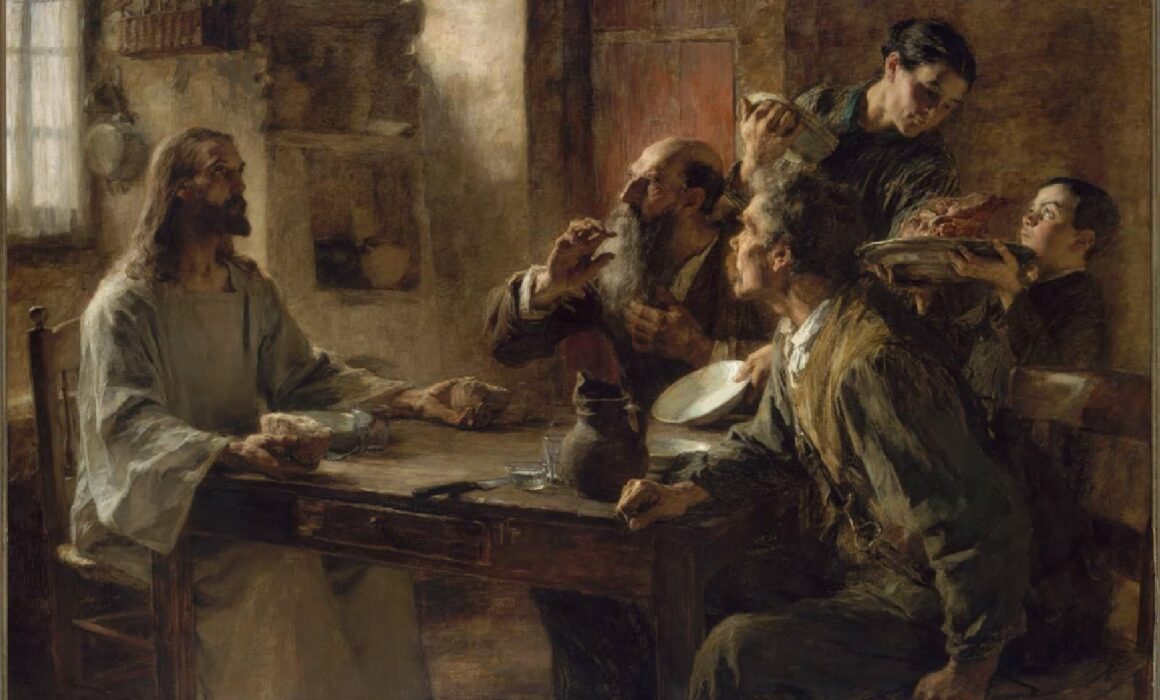
So God, before these two travelers, reveals where He will be found, and where He must be sought, ‘for when he was at table with them, he took the bread and blessed and broke it and gave it to them. And their eyes were opened, and they recognized him.’
It is in the Holy Eucharist dear Christians, in the Lord’s very own supper, that Christ now dwells with sinners, week upon week, and dwells within sinners, day upon day, and moment to moment. For never was He far off, for by the Sacrament of His Communion, He has been united to you in His flesh; He has placed His very humanity, united to His divinity, upon your tongue and into your body; and this as a pledge.
A pledge, that is to say, collateral. He is giving you something that is His, or more so, He is leaving with you His very self in the breaking of the bread. And for a simple reason. He doesn’t intend to forget it, for unlike us, He forgets nothing.
No, He leaves it with us and in us, for He is coming back to get it, and our flesh now bound to it with Him.
It is then that we shall see, and see clearly. It is then that we shall remember, and remember in full. It is then that we shall sing the song, and sing it without end, as we tread the path with Christ to the bright presence of the Father:
‘For you have delivered my soul from death,
my eyes from tears,
my feet from stumbling;
I will walk before the Lord
in the land of the living.’
+INJ+
Preached by Pastor Fields
Sermon Texts: Acts 2:14a, 36-41; Psalm 116:1-14; 1 Peter 1:17-25; Luke 24:13-35.