
The Sixth Sunday of Easter
Christ is risen!
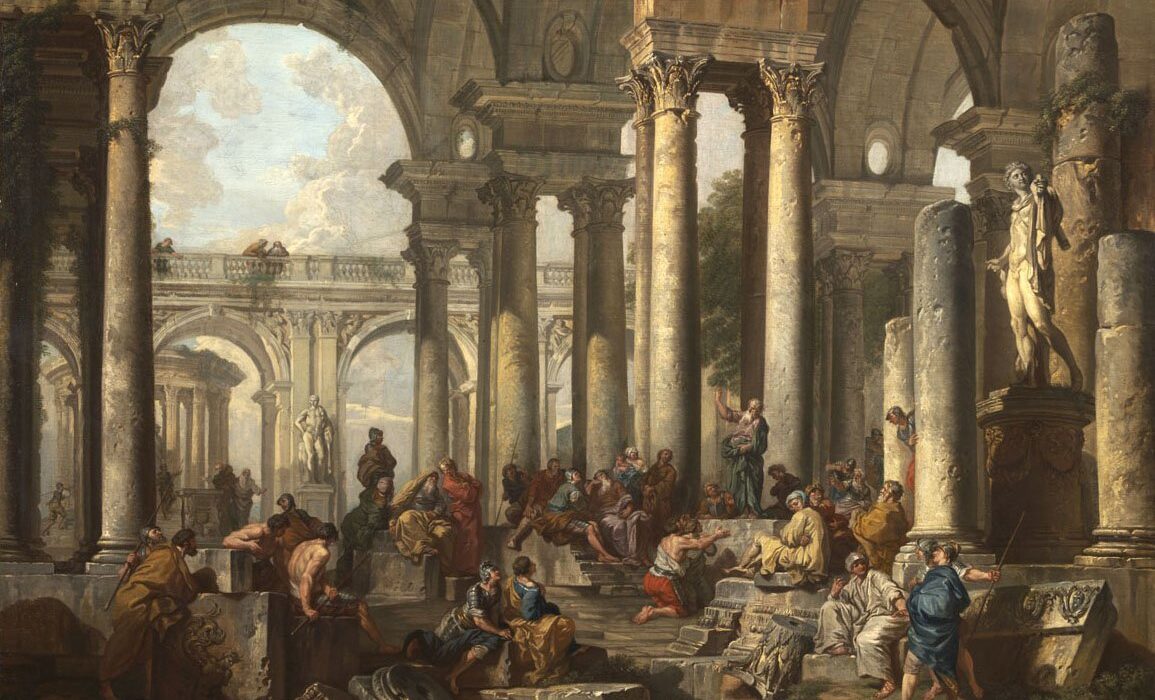
Therefore it is written, ‘Men of Athens, I perceive that in every way you are very religious.’
+INJ+
It is a peculiar pessimistic pass-time of today’s conservative-leaning Christian to everywhere possible bemoan the increasing secularization of American society. We talk about how God is being pushed out of the public square, how God is being pushed out of school, out of the courts, out of the Law, out of the University, out of our lives.
We speak at length about how our nation is a Christian country, and how a Christian country like ours cannot long stand without, well, Christianity.
We devise remedies to this situation, ideas that we hope will impose a minimal amount of piety on the general public in order to suggest to their minds, through minimal government action, the importance of our religious heritage.
We fight for prayer in the classroom. We vote to erect little statues of the Ten Commandments outside of our tribunals. We keep the ‘Christ’ in ‘Christmas.’
It is very much the case that Christianity is no longer the societal force it once was in the days of yore in our country. It may very much be the case that as our society rejects the Christian faith more and more, so will the foundations of our morality, our civic life, and our social bonds be dissolved, so that whatever was once recognizable as ‘America’ will dissipate and eventually be replaced with what is now becoming the norm in the modern world of statecraft, a forever ailing country guaranteeing a modest degree of comfort to its hopeless populace, so that they can live without starving and die without pain.
This all may be the case, that without the Church, which has always been the beating heart of our civilization, our culture will no longer have any heart at all, nor a soul, and will become nothing but the political equivalent of a corpse supported only be the beeping tubes of an antiseptic hospital cell.
However, it is not the case at all that America is not religious.
To be religious means simply to be bound again to something. One can see this in the Latin of the word: ‘re-’ meaning ‘once more’ and ‘ligio,’ the word where we get ‘ligament’ or ‘ligature,’ meaning ‘to tie up.’
And we are indeed ‘tied up’ to a great many things.
Religion is not first and foremost a set of doctrines and beliefs. It is first and foremost a thing of respect, or what the Scriptures would call fear. A religion is the set of those things that a person loves for what it is able to do for him, and fears for what will be done to him if he lacks those things.
We express our fear and love not primarily in writing treatises and confessing creeds, but in veneration, worship, and exaltation. We express it by what we do to honor that which we worship.
If an ancient Roman were to be transported to our own time, and were to hail a taxi in our capital of Washington D.C., he would in no-wise be under the impression that we ‘have no gods.’ He would, like St. Paul, look upon the many statues and temples erected in that city, and recognize in them the worship of the people who built them.
He would be driven by the Pentagon, and think to himself, ‘such a massive building, built like a star, and filled with soldiers; these are worshippers of Mars, the god of war.’
He would pass the Treasury Building, and think to himself, ‘what beautiful Ionian columns, and what a magnificent plaza; these are worshippers of Pluto, the god of wealth, and of death.’
He would see across the river the Lincoln and Jefferson Memorials, and think to himself, ‘these are their deified rulers, their great men, who through their service to the state, have ascended to the realms of heaven.’
He would in no-wise be under the impression that have no gods, nor that we are in any way a ‘secular society.’
Rather, he would say to his taxi driver exactly what St. Paul said to the Athenian philosophers: ‘I perceive that you are very religious.’
And indeed we are, for we fear and love many things, even as the ancient pagans did. We love strength and military might for the security that it can afford us, and we fear the chaos that will ensue in the world if we lack our ability to ‘project power.’
We love money for the pleasure that it can bring us, and we fear the want and destitution that we will suffer if we are just ‘barely getting by.’
We scream and yell and beat one another, in protest and counter protest, either in love of our President, or vehement hatred of the same, because we all know that our beloved leader will lead us to the floor of heaven, and our despised ruler shall make his rule a living hell.
We worship, we fear and love, many things; many created things; many, what the Bible calls, idols.
It is important to understand this. Our pagan ancestors did not think that there were giant people literally hopping around having drinking parties and dancing on Mount Olympus. Mount Olympus is a real place. You can see it. There are no people on it. They were not uneducated simpletons too stupid to understand the world, and so they invented ridiculous myths to explain the world around them.
Rather they understood the world around them very well, what was powerful; and they understood themselves very well; what had power over them; and they did the reasonable thing: to show that which is powerful the respect it deserves. So they, like us, built buildings and statues and held celebrations in front of them, that their respect might be observed.
Our society, right now, is in every way very religious.
It is written that St. Paul, like our Roman time traveler, entered the great city, and noticed that it was full of idols
It is interesting that St. Paul does not go into the Areopagus, as we think he should, and begin to rail against the pagan gods. He does not rant about how there is no god but God, and Jesus is His Christ. In some sense, he does not try to convince the Greeks gathered before him of what we now call ‘monotheism.’
He doesn’t do this because he must admit that all these things do have power in this world, money, the state, war, and a thousand other things. They are, in a sense, gods, and they are, in a sense, very real.
Instead, what he preaches is that the gods that they worship are not near to them. The gods that they worship do not care for them.
He comes to them preaching a God whom they recognize, but do not know, an unknown god, a god that cannot be seen, and cannot be touched. One that cannot be contained in temples made by man, and cannot be appeased by sycophancy, as though he needed anything.
Rather, He is a God that is everywhere, He is a God that is not far off, and He is a God who can only give, for in in him we live and move and have our being.
Indeed, the Lord is not far off. Indeed, He is, as the ancient theologians would say, ‘closer to us than we are to ourselves.’ And indeed, He can, and He will, only give, for the perfect gift for the one that has everything is the gift that can be given to those whom He loves.
The gift that St. Paul preaches is the gift of God Himself. He tells the Athenians that God has given Himself to all creatures, for He is existence itself, and all things exist, and only continue to exist, because He in every moment sustains them, in him all things cohere, all things have their being.
The gift God gives is the gift of his presence.
***
Our Lord Jesus speaks to us in the Holy Gospel.
He speaks of the gift that His Father will give. A gift that the world cannot receive. It is the gift of the Holy Spirit; the indwelling of the Trinitarian person within us, the Spirit of Christ, who proceeding from the Father and the Son will unite us to both in Himself, binding us together again to the entire Divine Majesty, to make us partakers of the divine nature, tying us up again into God, a most glorious religion.
This, that we might no longer be orphans, for we will be in the Son, the Son of the Father.
This, that we may live, for as he lives, we will also live.
This, that we may be loved, for we will be in the Son, the beloved Son, with whom the Father is well pleased.
This, that we might never again be alone, for God is not far off.
It is a sort of vogue, a fashion, in modern theology, to pit Jesus against Paul, and say that they taught two different religions; but that could not be farther from the case, for here, now before us, in this Areopagus, they preach the same sermon, for they proclaim to us anew what the Psalm once sang of old:
‘Come and hear, all you who fear God,
and I will tell what he has done for my soul.
For he has kept our soul among the living.’
+INJ+
Preached by Pastor Fields
Sermon Texts: Acts 17:16-31; 1 Peter 3:13-22; John 14:15-21.