
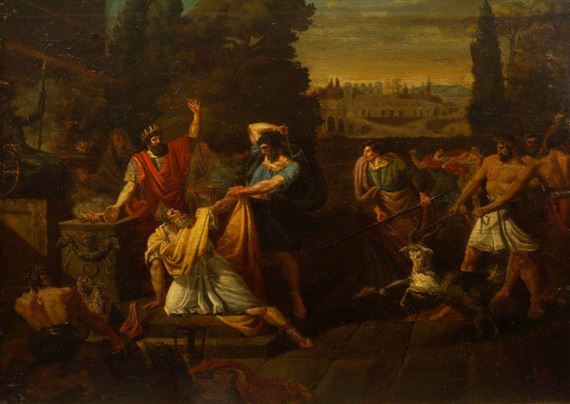
The Sixteenth Sunday after Pentecost
‘Then Peter came up and said to him, “Lord, how often will my brother sin against me, and I forgive him? As many as seven times?”’
+INJ+
The words of the Lord which we heard last week have not been lost on St. Peter. ‘Who is the greatest in the kingdom of heaven?’ they asked. ‘He who is like a child.’ The Lord responds. ‘He who remembers no wrong.’ ‘He who remembers not his own anger.’ ‘He who is pleased to welcome back the very one who has forsaken him.’ Which is to say, ‘He who forgives.’
Peter contemplates this teaching. He takes it into himself. But one question does he have. ‘How often will my brother sin against me, and I forgive him? As many as seven times?’
Often has this passage been taken by Christians, even pastors, as an opportunity to bash St. Peter. Indeed, it seems it is a vice of Lutheran sermons, at least in America, to put the saints in their place, and a lowly place it is. They say something like ‘Peter thinks he is proving that he is a great saint, he thinks he’s going to impress Jesus by going over the top. He will forgive his brothers. Maybe he will even forgive them as many as seven times! St. Peter wants a cookie after proclaiming just how forgiving he can be!’
Then such a preacher smiles and leans back with a little wry humor when he whips out Jesus’ reply to Peter ‘I do not say seven times, Peter, my boy, but seventy times seven!’ Wham! Boy our ol’ uncle Jesus really showed Peter who’s boss. That Peter, always full of himself, but not even he can impress the big man.
But here, we will not put ourselves in the seat of judgment.
St. Peter, blessed among the Apostles, asks an important question; how often shall one’s repentance be accepted, how often will it be believed, before we finally call that person a liar? Are we to accept the one that has wronged us back into our lives, back into the community of the Church, again and again, even when it becomes clear that that person has no intention of changing his life, no intention of mending his ways, no intention of living peaceably with others. How often do we have to pretend to believe these people who claim to be sorry for what they have done, and who claim to want to be forgiven, before we finally speak with our Lord, ‘verily, I say unto you, I never knew you.’
If we think for but a minute, and put what is being said into even the most basic real-world scenario, we begin to see that St. Peter, offering to forgive seven times, is extreme already, and that our Lord commanding not seven, but seventy times seven is absurd.
‘Lord, how often shall I give a twenty to that beggar for food, only to see him a few hours later passed out by the side of the road with a bottle of vodka in his palm? As many as seven times?’ ‘Not seven times only, but seventy times seven.’
‘Lord, how often shall my brother borrow money from me to start a new life, only to go and spend it on drugs, and I should bring him back into my house? As many as seven times?’ ‘Not seven times only, but seventy times seven.’
‘Lord, how often shall my wife cheat on me, and I should forgive her and pretend we have a happy family? As many as seven times?’ ‘Not seven times only, but seventy times seven.’
‘Lord, how often shall my husband beat me, and then come back a week later saying he is sorry, and that he won’t do it again, and that he will get counseling? As many as seven times? ‘Not seven times only, but seventy times seven.’
‘Lord, how often shall my child be molested, or kidnapped… or worse…’
When put into any actual real-life situation, any real sin, it seems absolutely insane that one would forgive such people. We view people as saints when we see the parents of a victim at a trial give a statement forgiving the murderer or rapist of their child. But if they were to go to seven trials for the same man, and forgive them for attacking their child seven times, we would not think them a saint; we would think them complicit.
The Church, in her history, had no easy time squaring this circle. In the times before the legalization of Christianity, this very question arose. Those who had been baptized, when captured by Roman authorities, were commanded to not only recant the faith, but also give the location where other Christians would gather for the liturgy, that they too might be arrested, lest they be put to death.
Fearing the loss of their mortal life, they gave in. They would denounce Christ, and point the finger to the house on the corner where the body and blood of our Lord was offered.
Many more Christians would then be arrested, and among them, many would not be so quick to curse the name of Jesus, and so they would be put to death, in large numbers, all because of the one apostate who was afraid.
Yet some of these apostates who betrayed the Church would return, and beg to return to the table of the Lord. Many bishops absolutely would not allow their return, accusing them of denying the Holy Spirit, and therefore beyond salvation.
Some counseled that they could be returned to the Church but once, but if they ever sinned against their fellow Christians ever again, there was no more hope of reconciliation.
But still others, among them St. Augustine, spoke the word of our Lord, and a word that none among those who had been betrayed, who had had friends and relatives put to death because of the faithlessness of these traitors, wanted to hear: ‘You shall forgive them, and bring them back into the church, as often as they repent, and ask for forgiveness.’
This gave rise to the practice of penance, that those who sinned against the Church could be brought back again and again, save only they complete their ecclesiastical punishments.
I am not about to solve this question for you anew. Nor am I about to counsel all of you, as afflicted as we are by those wrongs we have received in our past, on how you must forgive your abusers, molesters, sexual assailants, and whatever else.
When we pray the Lord’s Prayer, we pray ‘forgive us our trespasses, as we forgive those who trespass against us.’ This is not to say ‘forgive us to the same extent as we forgive others.’ Rather it is a prayer that God would forgive us our sins, and also give us the strength to forgive others. The prayer is a confession that forgiveness is not at all easy for us, and sometimes seems impossible; impossible without the strength from God himself, who makes all things possible.
It is not possible for man to forgive and forgive… not when we speak of real sin, upon real sin.
But our Lord speaks of Him who is greatest in the Church; He speaks of Him who is the head of the Church; which means He speaks only of Himself. For the Church is the body of Christ, and in His body shall every sin and abuse and hatred and attack be received, be endured, be suffered, and not only seven times, but indeed seventy times seven, that is, the whole number that is necessary in order to bring sinful mankind to rest in Him.
It is our Lord Jesus who pleads before the Father, and it is the Father alone who forgives, even as Christ prays, ‘Father, forgive them.’
And it is our Lord Jesus alone who receives the evil of our iniquities, as it is written, ‘against you O Lord, you only have I sinned,’ for indeed, ‘he bore our sins, and carried our sorrows.’
For the beggar does not ask you your money, then spend it on alcohol. No, he strips the Lord of His cloak, and your drug-addicted brother rips off His tunic, that the Christ walk naked and spat upon before the jeering public in Jerusalem. The Father looks upon the Son, ‘how often, Son, shall I forgive these who strip and steal from you? As many as seven times?’ But the Son replied, ‘No, Father, not seven times, but seventy times seven.’
His Church commits endless sins, abuses countless of its own people, teaches boundless heresies, and whores with every god of the culture, that the name of Jesus is reviled among the nations as He treads to the palaces of the Roman rulers. ‘How often, Son, shall I forgive these fornicators and adulterers, this Jezebel and Gomer in your house? As many as seven times?’ ‘Not seven, my Father, but seventy times seven.’
Endlessly, the nations and all that are in them are filled with violence, even in this city, assaulting and falling upon one another with gun and knife, beating each other to death; but in doing so, they only flog and flay the Lord Christ, that His holy blood may flow, and flow from His sacred face, as He bears the cross to the Mountain of the Sacrifice. ‘How often, Son, shall I forgive?’ ‘Seventy times, Father, and seven more.’
You, dear soul, in all your doings, sin only against the Christ. Because of you, He took on flesh, that you might kill Him, that He might be for you a scapegoat and a sacrifice. You murdered the Lord of glory, in every unkind word, in every ungracious act. This, you do, for you have cursed the bleeding hands and feet of the Lord. ‘Son, how often shall I forgive them?’
And the Son stops the mouth of the Father. He ends the Father’s questioning. ‘Father, forgive them.’ ‘Forgive them, until my sufferings are complete.’ ‘Forgive them, until my peace be with them always.’
You, dear Christian, have entered this house. Our Lord has taught, it is nothing but a house of forgiveness; and the great one in our midst, is one who forgives. Even now, the one you have slain gives His body to eat, and His blood to drink. Go to Him now, and ask forgiveness, even one more time, and greet Him with a kiss.
Greet the Lord of Grace rightly. And,
‘Bless the Lord, who forgives all your iniquities, and heals all your diseases.’
+INJ+
Preached by Pastor Fields
Sermon Texts: Genesis 50:15-21; Romans 14:1-12; Matthew 18:21-25.