
The Fourteenth Sunday after Pentecost
‘From that time Jesus began to show his disciples that he must go to Jerusalem and suffer many things from the elders and chief priests and scribes, and be killed, and on the third day be raised.’
+INJ+
It has not been long since St. Peter made the good confession. The Lord asked him, ‘who do you say that I am.’ St. Peter does not hesitate. He has seen the works of the Lord. He has heard Jesus’ teaching, teaching as one with authority.
For He is indeed one who utters what is precious; who has become as the Father’s mouth.
And so, St Peter answers his master: ‘Thou art the Christ, the son of the living God.’
The Lord rejoices, for Peter has received the grace of God, that faith might be created within him. He has said that which until then only the angels have spoken: that the Son has taken of flesh, that the man Jesus is the very God of the universe. And upon this confession shall the Church of our Lord be raised; the confession of St. Peter as the first stone among countless more that shall be added by every Christian who takes upon his lips the word and faith of the first of the Apostles.
So the disciples and Jesus go on their way, no doubt with great joy in their hearts; the disciples now being assured that their faith in Christ is true, and Jesus knowing that His true disciples have indeed been gathered to their Messiah.
But our Lord starts to do something rather confusing to His disciples. Immediately after having been proclaimed the long-promised deliverer of Israel, the anointed one of God, this same Jesus beings to show his disciples that he must go to Jerusalem and suffer many things, and be killed.
At first, it seems, St. Peter and the others do not dare to question the Lord; He has often said strange things before, dark sayings, speaking in parables and riddles. It is for this very reason that they believe Him to be from God! For so did the prophets before Him speak.
But still, they cannot help but be disquieted by Jesus’ constant talk of His destined doom.
‘Why does He speak this way? Have we not finally found the long-awaited king? Did He not reveal to us His origin in God Himself? Why then does He go on and on, about suffering, and agony, and extinction? Sure, we are used to Him saying weird things; we have even at times delighted in it. But what Jesus is saying now is strange, in that it is not so strange. It is strange because what He now speaks seems so very austere, so unambiguous, so very real. For perhaps the first time, He is not speaking in riddles. For the first time, He seems to be speaking clearly, so clearly it troubles our souls.’
Now Peter can no longer tolerate it. He tears Jesus aside, and rebukes Him. ‘Far be it from you Lord, this shall never happen to you.’
But Jesus does not explain Himself. He simply calls Peter the devil, and indeed he is, at least for a time, for he has not set his mind on the things of God.
It becomes too easy for us to think, ‘Well, Peter deserves to be attacked by our Lord, for obviously, He doesn’t think the same thoughts as God, as he is supposed to. Rather, the poor sod, he only thinks about the things of men.’
But what else is a man to think of? How could he possibly think as God does? How can he raise his mind to contemplate the maelstrom of contemplations which fill the divine mind?
That fact is, it is not possible, for God’s thoughts are not our thoughts, and His ways not our ways. For as the heavens are above the earth, so are God’s thoughts above all.
Peter cannot imagine what has been in the heart of God; what has made God to wet his bed with tears, what has brought pain to the Everlasting’s Spirit.
For all this talk of suffering and death, it seems sudden. It is a surprise. It is so very new, at least to St. Peter, for it seems to him that the Lord has never spoken these thoughts before.
But I tell you, these thoughts the Lord God has held, even for a thousand years. Even for all eternity.
****
We Lutherans often speak of the Old Testament being filled with ‘types,’ that is, images and words and events that point forward to what will eventually happen in the New Testament. We think of these types as a kind of literary foreshadowing, like God is giving a hint in Genesis and Exodus of what is going to happen in Matthew and Mark.
But to God, nothing is a shadow, nothing is a prophecy, nothing will ‘one day happen,’ for to Him, all things are present, and every age is imminent.
What was it for Adam and Eve to sin, and to hide their nakedness behind the leaves of a fig tree? The Lord curses them, as well as the serpent, and then slays an animal, that with its skins, He might clothe our first parents. We look at this, and simply say, ‘the slaying of the animal is a foreshadowing of Christ being crucified to cover our sin.’ That is all well and true; but to God, it is not a foreshadowing, it is a decision; for in slaughtering the animal for its skin, He has, from the beginning of the world, now condemned Himself to death; for He cannot go back on His word; and what He has revealed in the clothing of Adam is a sentence upon Himself that now binds Him.
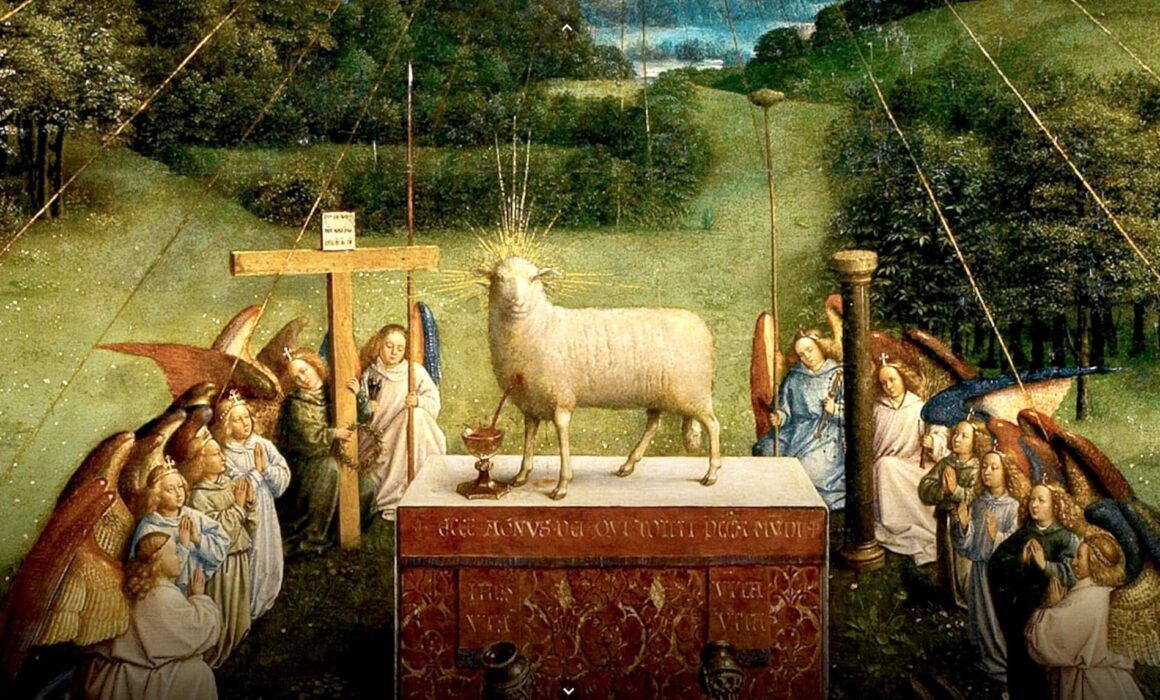
He calls the sons of Israel out of the land of Egypt, and that they might be spared of the tenth plague, and be delivered from the Destroyer, the Angel of Death. He commands that all the Hebrews sacrifice a lamb, and paint the posts of their door with its blood. We again take this as a sign and symbol of a future event, the sacrifice of the Lamb of God; but what is here revealed to us is the inner and constant meditation of the heart of God, that from the days of Adam until the days of Moses, He has not yet ceased from contemplating His own death, and in contemplating it, in every moment, committing Himself to it.
And again by the prophet Isaiah, the Lord speaks of His exiled people, and speaks of Himself, the suffering servant, who shall be pierced for our transgressions, and crushed for our iniquities. The prophet does not make a prediction. He only relays the thoughts of God.
Indeed, our Lord has not ceased contemplating His death, His sacrifice, His suffering for His people since the day of the fall of Man. He keeps the vision of His crucifixion forever before His face. Even more than this, all things are always present before God, and so He has not merely thought upon His Passion, but in every moment from the beginning of time has experienced it.
Our God is forever crucified, forever suffering, forever bleeding His sacred blood for the sins of the world, even as He forever looks forward to this same sacrifice; even as He forever receives this same atonement.
Even now, the crucifixion is not a past event to God, but even now binds Him, for so has He willed, that in this manner, He would forever be offering Himself to cover our iniquities before the face of the Father.
St. Peter is confused by the Lord’s words about His coming suffering. To Peter, it all seems so new. But new it is not, for it has been the constant vision before the eyes of God from the beginning of all creation. For this is what is meant when St. John writes, ‘he was slain for us before the foundation of the world.’ Even before the world was created from the love of God, that love first bled for its life.
What, then, are these things of God that Peter cannot grasp? What are these thoughts and ways of God that man cannot fathom?
It is nothing but the crucifix that sits upon this altar; it is, and only, the fact of the crucified God.
St. Peter cannot understand, nor can we, the compassion of the heart of God that for so long has suffered, and for so long ever will. The God who even in the life of the world to come shall be as a lamb that was slain, even as He dwells among the saints in glory; who even after His resurrection yet shows his wounds to Thomas. The God who bleeds, even now, to fill the chalice of this church. The God who is broken, that by His flesh we might be filled; we, who murdered the Son of Good Friday, even as the Hebrews slew the paschal lamb.
‘If your enemy is hungry, feed him. If he is thirsty, give Him drink.’ This is not merely fatherly advice given by St. Paul. It is the everlasting plan of salvation that our God has ordained to suffer from all eternity.
So what then are we to do? With St. Peter, how then shall we live? Such thoughts are indeed too lofty for us, and such ways we cannot reach.
But it is not ours to think God’s thoughts, nor to walk His ways; for he alone goes before us to Jerusalem.
Rather, it is ours alone to be united to our God, who in love for us has united His Godhead to us in the person of the Son.
We have been baptized into His death; and now we live from His resurrection. We have taken up His cross in Him, and we follow Him now to the presence of the Father. For even in His death, He is gathering all people to Himself, even as when He is high and lifted up, he shall draw all nations.
This, that we might stand on level ground,
‘That in the great assembly, we might bless the Lord.’
For Jesus speaks, even now, to those who complete His sufferings:
‘I am with you,
To save you, and to deliver you.’
+INJ+
Preached by Pastor Fields
Sermon Texts: Jeremiah 15:15-21; Romans 12:9-21; Matthew 16:21-28.