
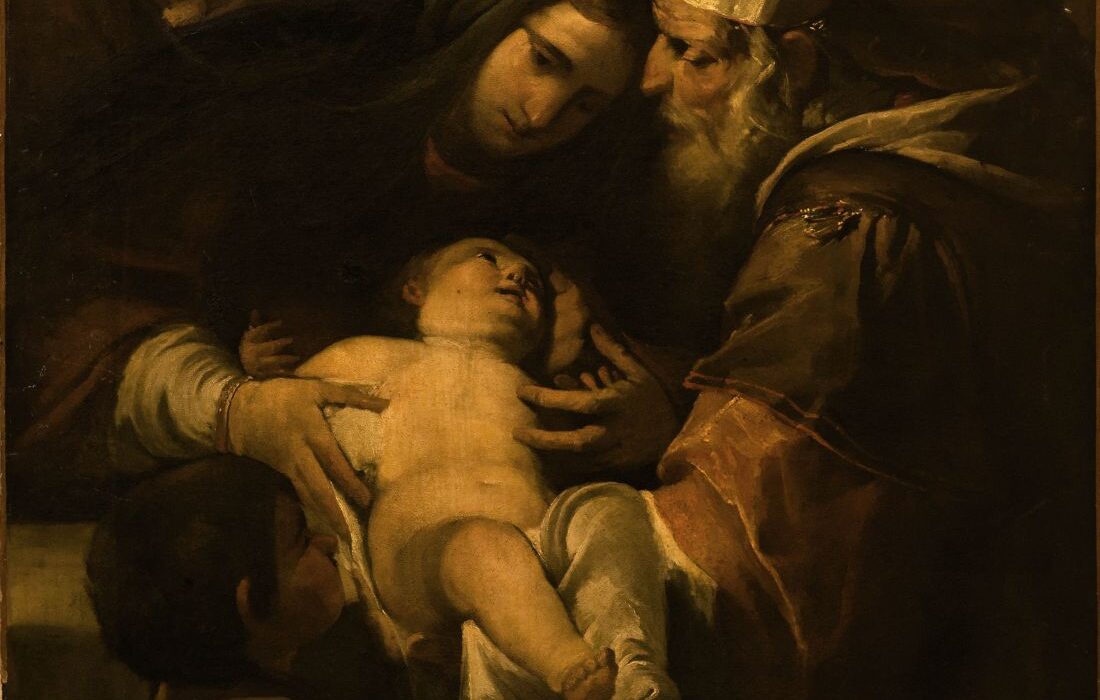
The Feast of the Purification of Mary & the Presentation of Our Lord
‘A sword shall pierce through your soul also.’
+INJ+
‘I shall greatly multiply your sorrow in conceiving. In anguish shall you bring forth children.’
This is the curse placed upon women by our Lord upon our first mother Eve having been seduced by the serpent. To bring forth children, to go into labor, to cry and cling and yell; these are the burden placed upon women when they must renew the human race, one child at a time. A sorrow in bringing forth children.
It is not for no reason that we call the process of giving birth a ‘delivery.’ Nowadays, the idiom has changed. We say that the child is being delivered by the mother and her company, as if the mom is dropping off a child like a UPS man dropping off a package two days late, with a bit of a sense of haste.
Yet that is not how the saying originally went. Go back to the old King James or anything written before the 1900’s and you will see that it was not the baby that was being delivered, but the mother. ‘And it was so, that, when the days were accomplished, that Mary should be delivered.’
I think most mothers might find this formulation of the saying to be more accurate. A baby is surely born, but it is the mother who is being delivered out of the midst of her suffering.
Yet as much unpleasantness as there might be to accompany childbirth, it is more than made up for by the happiness of holding the new life which she has nurtured in herself. ‘A woman when she is in travail hath sorrow, because her hour is come: but as soon as she is delivered of the child, she remembereth no more the anguish, for joy that a man is born into the world.’
Perhaps the process of childbirth could be considered a bit of a wash, all in all. But that cannot be said of Hannah, and all those who share in her tragedy. She is barren, and is condemned to never know either the suffering or its joy.
These days, there are many who will say that being infertile is no big deal, that women do not need children to be fulfilled, that they should pursue their own self-development without the yapping mouths of little people constantly assailing them. They even argue that this is a better way of life, a more pleasant one. They will argue that the only reason women in olden days needed children was because of their economic importance, that you needed kids to work the land or carry on the business, to care for them in their old age.
But that is no longer important: a woman can make her own money while she is young, and Social Security and Medicare can care for her in her retirement.
Yet this is only an illusion, as the benefits of retirement are merely paid for by the children of others, and one only works because others once bore the children that one works with, and that make up one’s customers.
Ultimately, even economically, we cannot live alone, we must have other people, and other people only exist by the labor of women, of mothers, who give birth. Motherhood is our sole weapon against decay and death, and all other human travails exist only to support its mission.
For this reason, it is written, ‘it is not good for man to be alone.’ This is not a reference to Adam needing a wife so he won’t get sad. Rather his wife is given that he may have a helpmeet in creating a family, then a clan, then a tribe, then a society, then a nation, that it may truly be said that mankind is no longer alone.
To be cut off from the ultimate importance of this divinely ordained mission is what it means to be barren, and it is for this reason that, to Hannah, it is rightly conceived of as a tragedy.
Yet the Lord hears the tears of her crying. It is written that she prays ‘God has heard the abundance of my complaint.’ Unlike the long litany of gripes against God that we contemplated last week, the complaint of Hannah is different. She demands not that she might be freed from the weight of God’s will, but rather that she be allowed to participate in it; that she might bring life into the world.
But it should not be said that the curse given by God to Eve and all women is undone in the barren Hannah having conceived, or in the delight of a child undoing the pain of the delivery room. In the end, the curse has nothing to do with being barren, or feeling pain.
It speaks of sorrow in conception, and anguish in birth. This is not an issue of reproductive health or human anatomy. The sorrow in forming a life, and the anguish in bringing that life into the sunlight is the knowledge, the knowledge of good and evil, that knowledge that all life, because of the sin of disobedience, will one day die; that the original loneliness of Adam will return, that every effort the sustain humanity that the mother makes is ultimately futile, for all will return to the dust. Rather, this life that we are given is not ours to keep, it is for but a time, or as Hannah puts it, it is a loan. It is a sword that shall pierce your soul.
Because of this, she loans back her son to the Lord. Her son, who would be named Samuel, is consecrated a Nazirite, and dedicated back to God, sent away to be raised by others.
Hannah recognizes that her child was never hers. For this is what the Law of Moses teaches: ‘Consecrate to me all the firstborn. Whatever is the first to open the womb among the people of Israel, both of man and of beast, is mine.’
This was to be done in a simple manner. The firstborn was to be sacrificed upon the altar. The firstborn of all livestock were slain and killed and given back to God. The firstborn of the donkey would have its neck snapped first, then offered, a symbol that the people of Israel would themselves be given back to God, if only through having their stiff-neck broken. And yes, the firstborn of all women would again be sacrificed to God.
Such was the sacrifice demanded of Abraham, and in faith Abraham went forth to make it.
Yet there is a little bit of a work-around built into the Law of Moses: ‘you shall redeem the firstborn son among you with a lamb.’ It seems like a good deal, kill the lamb, keep the child.
Yet this is not done by way of mercy on the part of God. Rather, to redeem the child is a confession. It is to say that one’s child is a sinner, and therefore unworthy of being given as an offering to God. Rather, a dumb, mute lamb would be better suited to the holiness of God, for at least it does not raise its voice up against God.
For this reason Isaac was spared, and Abraham kept his son in the flesh, sacrificing a ram in his place, for Isaac was corrupt, a sinner, and unclean.
Yet the sacrifice of the first born male is not thereby abrogated, it is merely delayed, for no man is worthy to play the part.
The Ever Virgin Mary, the Mother of Our Lord and God, now goes to the Temple in today’s Gospel reading, during this ‘Feast of the Presentation of Our Lord and the Purification of Mary.’ She goes there precisely to make this sacrifice of a lamb, or, since they are poor, two turtledoves in its place, that they might redeem the Christ from the need to be poured upon the altar. Upon making this sacrifice, the mother would receive a blessing, the so-called ‘Purification’ at the hand of the priests, recognizing that she at least, symbolically, offered to sacrifice her son, and so had fulfilled the letter of the Law.
Yet Mary and her husband Joseph are interrupted. Before they can make it into the halls of sacrifice, to present their offering on behalf of Jesus, they are stopped, and in a most startling way. A stranger, this old man called Simeon, runs up to them, and grabbing their child, lifts Him up.
He begins to sing, this old man. He sings a song that seems to be one of death, that he might finally depart in peace, having seen the Lord’s Christ. Yet the song he sings is one of life.
He knows what perhaps no one else, not even Mary, fully understands. Simeon does not hold in his hands a newborn baby boy. Nor does he hold in his hands the lamb that shall redeem the people of Israel in their place, the Redemption. What he holds in his hands is what Isaac was meant to be, but could not; what all Israel was to offer, but could not. What he held in his hands was the only firstborn son, pure and undefiled, without sin or corruption. He held in his hands the sacrifice of the beloved Son, the one worthy, all that was ever asked of humanity from Adam unto the end of time: that One made in God’s image give Himself over fully into the heart of God Himself.
Simeon rejoices as he rocks the infant Lord in his arms, for he knows that what he now bears is the end of all sorrow in conceiving, and all anguish in childbearing. He holds now the death of death, and the life of the world. He brings to his lips the forehead of the end of this world, and kisses the beginning of the life of the world to come. Simeon rejoices.
Now Christian, in but a moment this church whom Mary mystically represents, shall bring forth the beloved Son to this altar, that the bread and wine might become for us the sacrifice of the beloved firstborn. And you will come, and you will sing, and perhaps with a muted spirit, you too will bring the Lord’s flesh to your lips, and kiss the chalice of His blood.
And in so doing, you, dear Church, will, like Mary, be purified, for the Lord has been made present.
From this little sanctuary, this house of sacrifice, you shall then depart in peace, and rejoice, for you will finally rightly pray:
‘We have thought on your steadfast love, O God,
in the midst of your temple.’
For:
‘His holy mountain, beautiful in elevation,
is the joy of all the earth.’
+INJ+
Preached by Pastor Fields
Sermon Texts: 1 Samuel 1:21-28; Hebrews 2:14-18; Luke 2:22-40.