
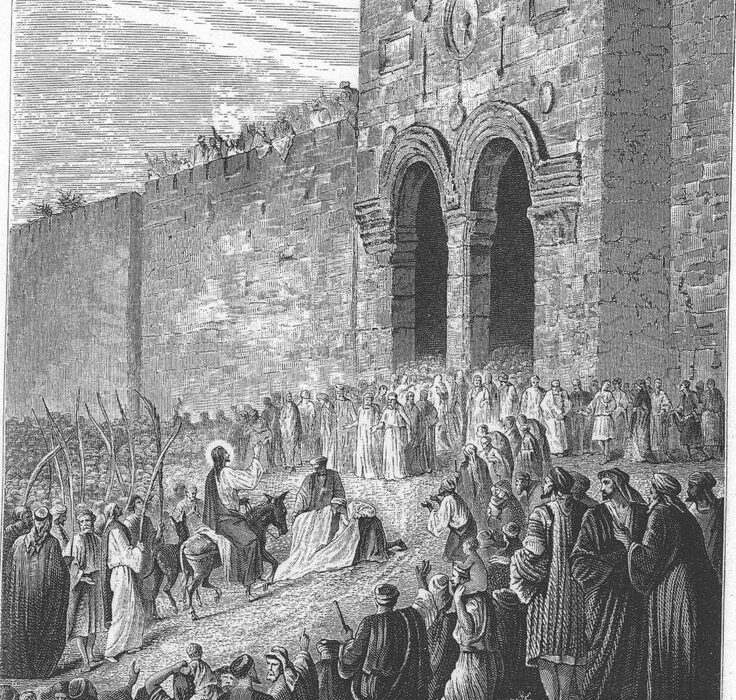
Palm Sunday
‘Have this mind among yourselves, which is yours in Christ Jesus.’
+INJ+
St. Paul speaks of having a mind among ourselves. A mind, a ‘way of thinking.’ Yet perhaps it would serve us to stick more closely to the literal meaning of the Scriptures. It is not a ‘way of thinking’ that it speaks of, but ‘a manner of breathing.’ It speaks of what we are to draw into ourselves, and store in ourselves, and have feed our body and soul, that it might animate us and cause us to move. Keep this breath within you, the breath that was first exhaled from the mouth of God into the clay of the Garden of Eden, that it might become Adam, a living soul.
‘How can clay do such great things?’ Not just clay alone, but clay in and with the Word of God.
What was breathed into the clay was nothing but burden of the Word, and with that Word, it was no ‘mere clay’ but a living soul. It became the Sacrament of a man.
It is this same Word that descended as the heavenly rain upon the parched earth in the incarnation of the Son, when that breath once again kissed the dust and ash of our nature, and the word became flesh, and dwelt among us.
Now St. Paul commands us to have this breath, this Word, fill us, which is ours in Christ Jesus. He speaks of it as a kind of gift, a present of sorts. It is ours, we got it from Jesus, and now it is only polite to put it on.
But what is this gift of breath, that must fill and feed and fuel our being?
That ‘being in the form of God, did not consider it robbery to be equal with God, but made Himself of no reputation, taking the form of a bondservant, and coming in the likeness of men.
It is the lone gift that is given to man in the beginning, the gift that sets him apart from the animals, and establishes him as a child, a son of God. It is the gift that we abandoned towards our heavenly Father, and took up instead toward our father the devil. It is the gift of Original Righteousness; it is the gift of obedience.
In our libertine age, where the individual freedom to indulge and satisfy our every lust, both base and elevated, is considered of the highest value, it is difficult, if not impossible, for us to understand how obedience can be a gift. We are a nation built on liberty; we despise authority; we will have ‘no kings.’ The glorious emblem of my home state of Virginia proudly reads ‘sic semper tyrranus,’ ‘Thus always to tyrants,’ the words emblazoned over the figure of Lady Liberty standing upon the slain corpse of a once crowned ruler. If freedom is our highest value, who could bear to be given a present such as this, a gift of obedience?
But perhaps, if the one we are obeying is all wise, and always looking out for our good; if he is indeed the ‘man with the map’ and the one who will show us the way, then perhaps to obey him is for our own good, and will lead us to where we want to go. Perhaps, with some conditions, obedience wouldn’t always be such a bad thing.
Yet St. Paul continues: And being found in appearance as a man, He humbled Himself and became obedient to the point of death, even the death of the cross.’
Our obedience does indeed show us the way. Our obedience does indeed lead us to where we are going. But where we are to go is not where we want. For it leads us to humiliation, and to death, even the death of the cross.
We have spoken of before how the great temptation of Satan is to believe that God is not good. It would seem, in light of this breath we are to take into ourselves, that that is no mere temptation. It is a damn good theory to explain why we, as Christians, must live as we do. That we must receive a gift. That that gift is one of bondage. That that bondage requires obedience. That that obedience leads to humiliation. That that humiliation leads to death.
What is it to us if, in that death, we have the hope of the Resurrection? That is just a hope, we tell ourselves. But our death is a fact.
Who, then, can possibly obey the will of the Father? Who then will be the Son? Who then will receive the bondage, and the humiliation, and the tree of suffering?
Who can bear the word that he speaks? Who can take the breath of this word within him?
Today we see a man named Jesus. Now He enters into the Holy City of Jerusalem. They cheer Him, they praise Him, they cry to Him for mercy.
They bless Him.
In all things they exalt Him who enters.
But this man Jesus rejects such things.
The Pharisees sneer at Him. They are terrified. They too notice the crowds assembling about the Christ. They are terrified that their prestige will be challenged. They snarl, and jeer, and in their petty jealousy cry out see, the whole world has gone after him!’
But you see, they are wrong. No one has come after Him, not a single one.
The Pharisees think that they see crowds assembled, throwing branches before the heir of King David. They think they see the masses thronging about His way.
But no one walks His way, no one treads His path. For perhaps they will follow the King of the Jews; but they will not follow the Son of God.
For a son is obedient, obedient to his father, even unto death, the death of the cross.
And obedience we all had forgotten long ago.
Perhaps it is too much what St. Paul asks of us, to have this mind among ourselves. But this mind, this breath, this word, it will indeed enter into this One.
The breath of God’s word will not enter into our mind, nor into our heart, for we are sinful, and unclean. But in the one riding upon a colt, the foal of a donkey, it finds a home.
The crowd thinks He rides off to His see and crown. Indeed He does. But it is not where they think.
Alone does the Son of the Father ride to place the crown of thorns upon His head. Alone does He process to be stripped naked and bare, to be pierced and mocked, to break upon His throne of blood.
Alone does He go, for He alone has this mind within him:
‘Morning by morning he awakens;
he awakens my ear
to hear as those who are taught.
The Lord God has opened my ear,
and I was not rebellious;
I turned not backward.
I gave my back to those who strike,
and my cheeks to those who pull out the beard;
I hid not my face
from disgrace and spitting.’
‘But I trust in you, O Lord;
I say, “You are my God.”’
+INJ+
Preached by Pastor Fields
Sermon Texts: Isaiah 50:4-9a; Philippians 2:5-11; John 12:20-43.