
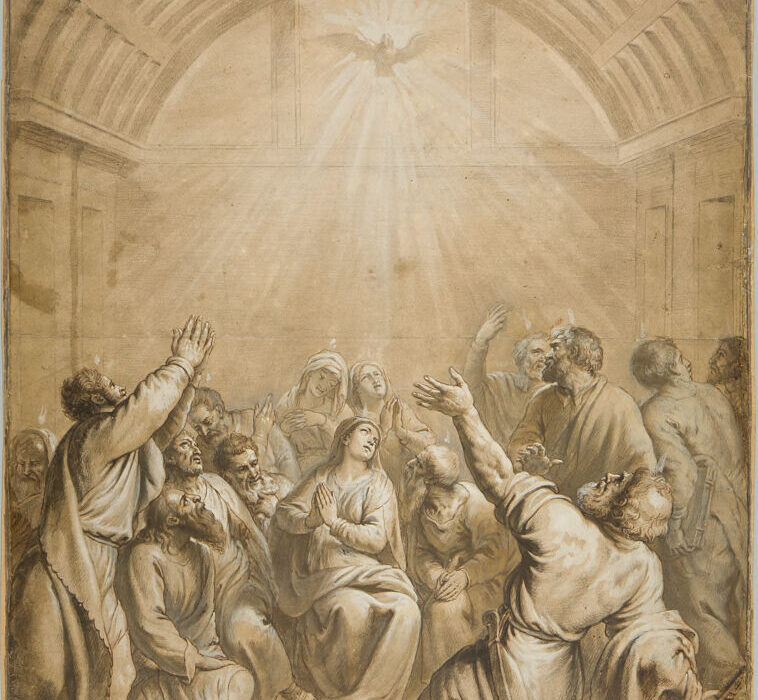
The Feast of Pentecost
‘And in the last days it shall be, God declares,
that I will pour out my Spirit on all flesh’
+INJ+
‘For thou only art holy, thou only art the Lord.’ ‘Holy, holy, holy, Lord God of Sabaoth, heaven and earth are filled with thy glory.’ ‘Lamb of God, pure and holy.’ These things we sing in the liturgy, we confess the holiness of God, and for this holiness, we give Him glory.
Holiness is a peculiar concept. Simply, it means to be set apart, at a distance. It is fundamentally a relational term. Something is ‘holy’ in relation to something else. To a sports fan, the baseball in the game is holy, something that one must not touch, unless it ascends from on high, and is made incarnate in the stadium bleachers. Otherwise, the ball is not to be touched. It is holy. But to the players, that is not so. To them it is simply the tool of their trade, and an entirely normal part of their everyday vocation of entertaining the people.
God is holy. But in relation to what?
It is our first impulse to say, ‘in relation to everything.’ And that is true, for He is indeed beyond all knowing, all comprehension, beyond all change, beyond all passion, beyond everything that typifies the created world. He is what the fathers would call ‘ineffable,’ that is, He cannot be contained by any language or any word, nor described accurately in any way.
It seems most pious to us to confess the divine essence, the very nature of God, in this way. He is so far away from us, that we do not even have the mind, or thought, or terms to speak about Him.
Yet the Scriptures reveal to us that He is not so equally far away from everything. For though He is set apart from the world, yet He is in the world, but not of it. Though He is set apart from our lives, yet in him we live and move and have our being. Though He is set apart from even the depths of hell, yet it is written: ‘if I make my bed in Sheol, behold, you are there.’
When in love He formed Adam, and planted within the first man His very own image, and breathed into his nostrils God’s very own breath; one cannot but notice the intimacy, the care. Of course God is always Holy, but in that moment when God set man in the garden, perhaps He seemed just a little less distant; perhaps, as we read not long ago, God was not far off. God descended to man, drew near to man, to be with man, for the Love of God drew Him down.
But the tale of the Old Testament is sadly not the tale of God and man walking in the cool of the garden. Rather it is the history of how God became ever more invisible to man; not because God has withdrawn, but because man hid himself.
If the weddings at Cana was the chief of the miracles that Christ would perform, that miracle which would define all the other works of our Lord, so it is that Adam enshrouding himself in the leaves of a tree would be chief of the works that man would perform, for in all things man would draw away further and further from God.
For He having despised the intimacy he first enjoyed with the LORD, Adam forsook the garden, and so God gave him the wish of his heart, and sealed the garden from him by a fiery turning sword.
He would wander the land, and labor in it, that He might eat bread. Yet man was not yet so far off from God that he could not speak to Him when he pleased. So Cain and Abel offered up sacrifice. Upon one, God had regard; upon the other, He did not. So brother rose up against brother, and violence entered the world.
Cain was sent to be homeless in the world, wandering always in an endless attempt to flee from the judgment of God; and violence and wandering and fleeing from guilt would typify the life of all his children.
So it came to pass that violence filled the earth, and the thought of man’s heart was only evil constantly. So the hand of God came down and touched the height of the heavens, and the depth of the seas, that all that had the breath of life might be wiped out, save eight souls, Noah and his family.
It might seem that when Noah left the ark, things might have improved. The evil in creation had been wiped out, Righteous Noah now steps upon dry ground. God promises not to ever again wipe out all life by the flood. Yet it is not as it seems. God speaks to Moses ‘whosoever sheds the blood of man, by man shall his blood be shed.’
What God is saying here is that no more will God exact vengeance against the violence and wickedness of humanity. Now man has wandered too far off, God is too much in the distance, and so now man will exact vengeance upon man on behalf of God. It is true that God will no longer wipe out human evil by a flood of waters. Rather He will hem it in by the blades of other violent men.
This is, according the Scriptures, the foundation of the institution of governments among men, of those ordained by God to bear the sword, that evil might be punished. It is not the case that God will no longer punish sins. He will just no longer do it in person. Now we have walked so far from the garden, that He will not even do that in person.
Yet men made a tower, one to reach towards heaven, that they might make a name. And in response, God confuses their language, that they might no longer conspire with one another, and so make their evil great by taking council together. Now nations would divided, tongue against tongue, tribe against tribe. No longer would one man punish the evil of another, nor one ruler exact vengeance upon the criminal. Now each nation’s evil would act as a barrier against the evil of another. This is the beginning of what we now call ‘checks and balances.’
For man no longer dwells with God. For man no longer speaks with God. For man no longer is guided by God. Now it is the endless war and competition between lands and nations that will, through fear, limit the evil of every human soul.
So it is today, where we have no fear of God, for we cannot any longer see Him. Rather we fear ourselves, and our neighbor, and our government, and the government of foreign lands, and through this patch-work of fears, we are kept on the path of virtue, if not in our hearts, at least by our actions.
It would seem that God has never been more separate, never been more holy. Yet this is not because He has gone any farther from us, for He is as near as He has ever been. Rather it is because our souls have fled so far from Him, for we are always hiding our eyes behind the tree.
So in the liturgy, when we sing holy, holy, holy, we not only declare the glory of God; we also confess our sin, for we know how far we have gone into a strange land.
But I would remind you of something that we have been saying during this season of Easter, right before you take communion. You hear the words, ‘the holy things of God for the holy people of God.’ Those words are actually some of the oldest recorded words in any Christian liturgy on earth, and are still used in the liturgies of almost all Lutheran churches, save for the LCMS.
Of course, we say this as we are about to distribute the Lord’s Supper. Of course, the Lord’s body and blood are the holy things of God. But who are these holy people? Us? How can it possibly be that we are holy? For if God alone is holy, then we can only be holy if we are wrapped up into God, or to use Martin Luther’s curiously preferred terminology, unless we are ‘godded through.’
It is for this reason, dear Christians, that it is written:
‘And in the last days it shall be, God declares,
that I will pour out my Spirit on all flesh.’
It is the Feast of Pentecost, dear Christians, and the crowds are baffled by what the disciples of Jesus now speak. God has poured out His Spirit upon the Apostles, and upon His Church, that they might be made holy through the Holy Things. That they might be made holy through the water, and flesh, and blood.
By the pouring out of the Holy Spirit upon the Church, we are made temples of the Holy Ghost, that God might forever dwell within these stones of flesh which we bare, and god us through; that we might be holy, as your Father in heaven is holy, and perfect as He is perfect.
Behold, I was not quite telling the whole truth when I said that we had wandered far from God, for if we had bothered to turn around, we would have noticed God following us, step by step the whole way through, sometimes by a pillar of fire, sometimes by a still small voice, sometimes in a wandering prophet, and sometimes in bread and wine and the feeble preaching of a degenerate pastor. Yet He followed, all of us together, and each of us, one by one.
That no longer we be cast out from the garden, but be assumed into heaven.
That no longer we be made to wander, but that we might dwell in the heavenly mansion that Christ for us has prepared.
That no longer we may be guided by fear beneath the sword of the government, for our citizenship is now in heaven, and the government shall be upon his shoulders.
That no longer we might be guarded against the threats of the foreigner, the other, the stranger, for behold, Babel is undone, the tower is fallen, and each one heard them speak in His own language.
All things that have fallen far from God are being drawn back into Him, and this by the sending of the Holy Spirit, who enters in you as a dove, that by its wings you might fly again into the nature of God, you and I and all who are called, that we might be one, as the Son and the Father are one.
Many of us have heard that the Hebrew word for repentance simply means ‘to turn.’ We were wandering away, and when we repent, we turn, so that, we suppose, we can start wandering back.
But to us who turn, we do not look to some distant goal, some holy garden, some ineffable God. We turn, and as a shock, we see, that though God let us wander far from Eden, He never let us wander far from Him, for He is there.
Come then to this altar, dear Christian, and receive the gift of the Holy Spirit, the very body and blood of God, confessing your sins, then as you kneel, lift up your eyes, and open your mouth before the hands of your pastor, and let your soul speak:
‘Make me to know your ways O Lord,
Teach me your paths,
For my eyes are ever toward the Lord.’
‘And he will show you the wonders of heaven above.’
+INJ+
Preached by Pastor Fields
Sermon Texts: Numbers 11:24-30; Acts 2:1-21; John 7:37-39.