
The Fifth Sunday of Easter
Christ is Risen!
‘Truly, truly, I say to you, whoever believes in me will also do the works that I do.’
+INJ+
People care for their own. It is part of our nature. Perhaps part of our fallen nature; yet nature it is. And we should not be too quick to condemn the partisanship of our obligations, as some modern people do, who believe that the only good morality is one based on indiscriminate, egalitarian ideals. After all, it is written, ‘Honor thy father and thy mother.’ We are to honor those whom we share blood with, to whom we are close.
We take care of those who we believe to be part of our circle. We leave those who are part of another circle to their own.
But in the Church, it seems things are different. There is no Greek or Jew, there is neither slave nor free, no male nor female; for all are one in Christ.
This is a lesson hard taught, to ignore those earthly bonds of affinity, those of kinship and kind, and instead view one another not as father and mother, sister, brother, countryman but as ‘Christians’, the name for which men do not merely bleed, as blood is thicker than water, but die, for the font has made water thicker than blood, and wine thicker than all the world.
Even in the Church, those who were of the Jews and of the Gentiles still separated themselves from one another. There was to be a distribution, that is, the Church was to take care of its own poor, its own needy. Yet when it came time to care for these, the old lines of solidarity, Jew against Greek, slave against free, rose up, and widows were neglected.
This is an intolerable problem, for our God draws all nations unto himself, and is no respecter of persons. Yet it did not seem proper to the Church that those who pray and preach and teach be burdened further by tending to the holy, beautiful, but yet still worldly needs of those who hunger.
They cannot be ignored, for it is godless to ignore the needy, but to tend to those who hunger of body, and to tend to those who hunger of soul; the Apostles determined that such tasks belonged to different people.
Therefore, the diaconate was established by the proclamation of the very disciples of Christ, and deacons and deaconesses were consecrated; an apostolic institution which this very congregation rejoices in.
So Stephen, the first deacon, was chosen, that he might serve the body of the Church, born of earth; even as the priesthood, that is, those following the succession of the Apostles, might serve the soul of the Church, born of God; for in the resurrection, both body and soul shall be raised; therefore, it seemed right that both be served as equal, great and glorious creations of the Lord, that together make the one neighbor, whom we are to love.
The Lord Christ in our Gospel reading speaks to His disciples. He asks a simple request: ‘Believe in my God; believe also in me.’ When the disciples are confused, asking that Jesus ‘show them the Father’, the Lord responds: ‘Do you not believe that I am in the Father and the Father is in me? The words that I say to you I do not speak on my own authority, but the Father who dwells in me does his works. Believe me that I am in the Father and the Father is in me, or else believe on account of the works themselves.’
‘Believe on account of the works.’
These works, what are they? It would seem obvious that the works must be His miracles. His turning water into wine. His healing of the blind. His purging of the possessed.
Yet Christ belittles these works. He belittles His own miracles, for He says that those who follow Him will do works as He does; but greater works than these simple miracles.
People misunderstand miracles, believing them to be God’s way of rewarding the faithful in times of great suffering or trial. This is not so. The Lord gives miracles because we are a stiff-necked people, uncircumcised in heart and ears, and always resisting the Holy Spirit, as our fathers did before us. A miracle is not a reward for faith, but a poison that drives out the poison of faithlessness. Indeed, ‘a wicked and adulterous generation asks for signs.’
The world is already filled with wonder, and has no need of miracles; the Lord of Hosts need only add wonders to it because of our blindness; because we will not see. It is important that we understand this, that when the Psalms and Prophets wish to point to the wonders of God, they do not recollect a collection of supernatural healings; rather, more often, they speak of the beauty and terror of the world He has made. They declare the mere existence of all these things, from the grass and its flower to the rivers, the mountains and their stars, to be an unending song of praise forever offered to their creator. For it is written:
‘The heavens declare the glory of God,
and the sky above proclaims his handiwork.
Day to day pours out speech,
and night to night reveals knowledge.’
So Christ, the Word, by whom all things were made in the beginning, and are sustained in every moment, does not esteem His miraculous doings as something to be praised, or praised for. Rather they are a bandage for sick and injured men with hearts of stone, and not of flesh.
But, again, our Lord speaks to those who believe in him, that they shall also do the works that I do.
The Lord Christ does not speak of His miracles, but of the greater works that will be done by His grace, won by His going to the Father.
What is this greater work? What is greater than healing the sick and raising the dead?
The Lord exalts the lowly. And indeed, the greater work the Son of Man speaks of is that work which all mankind spits upon. It is that lowliest of things; that most unscientific, most unenlightened, most foolish of things: that thing that we deride as ‘faith.’
Yet this faith is not mere assent to a series of religious facts. It is the invincible trust in the promise of the Father. Even when all hell assails us, it is not mere assent that will give us strength to endure the fight, but faith—that is, derision for all the cacophony and prattling of this world, and loyalty to the Gospel and Word of the Almighty.
Christ shows us this greater work; He shows us faith, for as He says Himself: ‘I am going to the Father.’ And there is but one path, one way to His Father, and that is through His cross, His Passion, His Hell. These things He endures, for above any miracle, He does a greater work.
‘Whoever believes in me will also do the works that I do.’
The works that the Lord does; the work of Passion; the work of suffering; the work of obedience to the seemingly absurd will of God in a seemingly lost and hateful world; to be delivered up to strangers and accusers; to be reviled and mocked; to be scourged and beaten; to be crucified, that those who know not what they do might know; that those who are blind might see. The Lord does such works, for He is going to the Father, that the Father might be glorified in the Son.
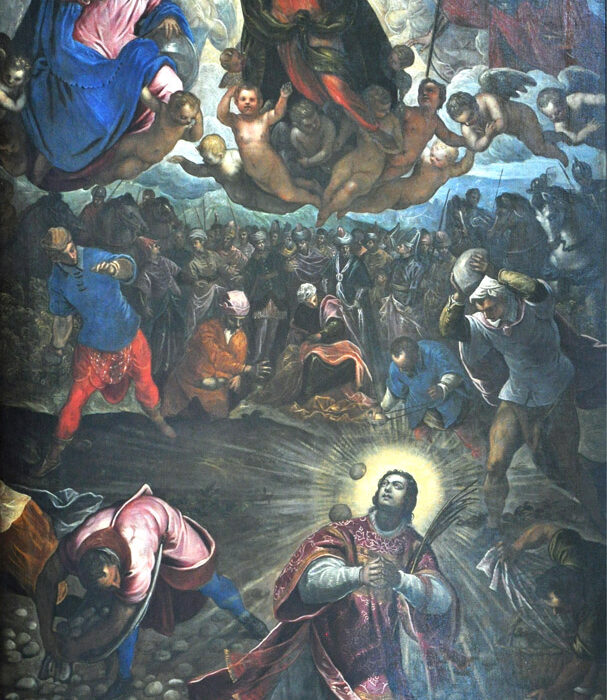
The first deacon, this Saint Stephen, does a greater work than all the miracles of Christ, for He imitates the greatest work of Christ, for he trusts in Christ even the darkest hour of hell. Having served the poor, the orphan, the widow, in senseless outrage, ‘they cried out with a loud voice and stopped their ears, and rushed together at him. They cast him out of the city and stoned him.’
And as the stone struck his skull outside the walls of the city, and blood filled his throat, he spoke the only words which innocent blood can speak, a greater work than all miracles. He spoke those words that only God can speak: ‘Lord, do not hold this sin against them.’ ‘Father, forgive them.’
It is the forgiveness of sins which all the works of Christ’s passion were accomplished to win. It is the forgiveness of your sins for which the divine Son pleaded from the cross, and stole from hell out of the grave. It is this work which was given St. Stephen to speak to the crowd of his murderers, a work greater than the signs. For it is this work alone that does not merely heal a man for the rest of his life, but gives a man life for the whole of eternity.
For here is the summary of Christ’s teaching: that His work is not His miracles, but His passion, in which St. Stephen has now become a partaker. His greater work is not His miracles, but the forgiveness His passion wrought, which St. Stephen now proclaims. Remember what the Lord said to those questioning His releasing the paralytic from his sin:
‘Which is easier, to say to the paralytic, ‘Your sins are forgiven,’ or to say, ‘Rise, take up your bed and walk’? But that you may know that the Son of Man has authority on earth to forgive sins”—he said to the paralytic— “I say to you, rise, pick up your bed, and go home.”’
This is the work of God, for by such forgiveness:
‘You also, as living stones, are being built up a spiritual house…
For you have now obtained mercy.’
+INJ+