
The Second Sunday of Easter
Christ is risen!
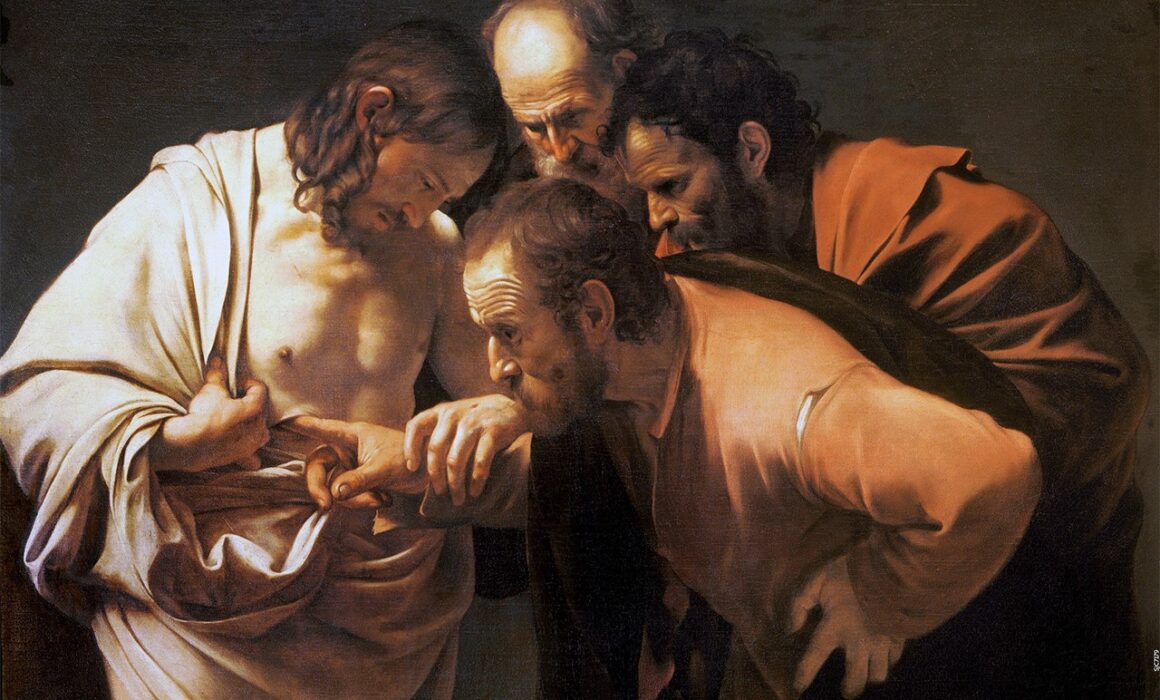
‘Now Thomas, one of the twelve, called the Twin, was not with them when Jesus came. So the other disciples told him, “We have seen the Lord.” But he said to them, “Unless I see in his hands the mark of the nails, and place my finger into the mark of the nails, and place my hand into his side, I will never believe.”’
+INJ+
The Lord has appeared to the disciples, His peace to give. The gift of the Holy Spirit He has bestowed upon them, that by its power, the truth of the Gospel might be brought to all nations. They shall go forth to the end of the world. They shall forgive the sins of those who repent, for the wicked who turn from their wickedness shall not perish. They shall retain the sins of the idolators, for they shall teach transgressors the ways of the Lord. By their labors will the Kingdom of God be built, His holy and purified Church.
The disciples run to St. Thomas, for he was not with them. He is the first one to whom the disciples shall declare the good news. ‘We have seen the Lord.’
But Thomas seems not to believe them. He doubts. ‘Unless I see in his hands the mark of the nails, and place my hand in his side, I will never believe.’
It is a story about belief, and about doubt. It is a story that belongs most totally in our own day and age.
Our society views itself as scientific, enlightened; we are proudly skeptical. We claim we always wait for evidence. Modern theologians ask, ‘is it still possible for us to believe?’ Even a recent Pope asked this question, and at length. The assumption seems to be that belief is the refuge of the ignorant. Among intelligent people, we demand proof.
However, this could not be less true. We believe, and we believe without proof, and we believe so constantly.
I remember a cartoon from when I was a child. A certain man is sitting in his living room watching TV when an ad comes on for a product called ‘Chambragne,’ a shampoo filled with ‘magical knowledge crystals’ that claims to increase your intellect simply by being used in the shower. After the ad, the smiling man proclaims, ‘I believe every word that man just said, because it is exactly what I wanted to hear.’ After the scene cut, you see the man standing around dozens of crates of the product and suds on his head. He simply says, ‘I don’t need to be a rocket scientist to know that this is working!’
It would be funny if it were not so true. We seem to believe anything, as long as it is something that we want to believe. We trust in strange remedies and crystals to heal us. We trust in lifestyle fads and fitness routines to transform us.
Even our politics is built entirely on our blind trust in what we want to believe: almost everything on the news is some form of a half-truth, or a half-lie, but if it affirms our political worldview, we blindly accept it.
Those who consider themselves skeptics are skeptics simply because the alternative explanation they find more affirming of their ego. Those who deny the moon-landing rarely do so because they have proven that the moon landing was impossible. They deny it because to do so makes them feel like part of a small gathered few wise enough to see through great national lies. It makes them into prophets.
We all trust in authorities to tell us the answer to Pilate’s great question: ‘What is truth?’ But to us, most of those authorities are faceless, and dwell on the internet.
And whatever they say, as long as we like what they say, we believe.
Yet perhaps from time to time, we are aware enough not to simply believe something because it’s what our itching ears seek to hear. We hear something, we see something. But sometimes we still can’t believe it.
Generally, there are two reasons why we still won’t believe what we have seen or heard, and again, it has very little to do with our intelligence or the presence of proof.
Either it is too good to be true, or it is too bad.
Many men have the experience of doubt because what has happened is too good to be true. After all, they got married. They had the experience of looking at their bride, and saying, ‘did she really just become my wife?’
It is not at all uncommon for us to disbelieve something because we become skeptical of ourselves, we do not want to believe something just because we want it to be true, and so we doubt it even in the face of the evidence that it is true, like a woman’s bewitching smile as she looks at you, and seemingly only you.
Yet sometimes we do not believe something because the fact of its truth would be so hateful that we cannot bring ourselves to accept it. This psychiatrists call ‘being in denial’ and we all are very much prone to it. I remember when I received a call from a friend of mine in Paris to tell me that, first hand, he was watching Notre Dame Cathedral burn. Even with the evident panic and despair in his voice, I couldn’t bring myself to believe what he was telling me. Instead I went to the internet to see if there was any reporting on it. After seeing two or three stories, and a live video of the fire, I finally, and only barely, accepted that perhaps the most beautiful building ever made by man was destroyed forever. And I need not bring up how so many of us felt who were there during the attacks on our country on 9/11.
The point is that we are not a people beyond belief. We are not a nation of sagacious skeptics seeking proof and empirical data. We believe, and we doubt; and what we believe, we believe because it pleases us to believe it; and what we doubt, we doubt because it is too painful to believe.
So now, St. Thomas is told something that he will not believe. He doubts, and we must ask why.
Surely he would want to believe that his Lord is risen. In fact, it is the thing that would please him the most. Yet he doubts, for he is not like us, believing whatever tickles our fancies.
Perhaps he doubts because it is too good to be true, for in fact, it is too good. Yet interestingly, he seems rather to think it is not good enough. The disciples have only said that they have seen the Lord. Such could be a vision. Such could be an illusion. Perhaps they saw a revelation like St. John one day would, or the ancient prophet Ezekiel. But seeing a vision, even from God, is not at all what the Christ had promised, that on the third day, he would rise from the dead, or what the prophet Job hoped, that in my flesh, I shall see God; that He shall stand at last upon the earth.
It would then seem that he cannot believe, because what he is told by the others is, in fact, too bad; and this is the truth.
Perhaps St. Thomas believes that the disciples have seen something, maybe even seen the Lord. But what he doubts is not what they have seen, but what they seem to be suggesting, that Jesus has been raised from the dead.
St. Thomas is not a fool, nor was he ignorant. He listened to the prophets. He listened to the Lord. He will not believe some silly story that their Lord appeared to them in a dream or vision, nor in some spiritualist fantasy that He came to them as a Spirit. He knows that the resurrection will be a resurrection not just of some part of Jesus, but all of Him, for if the Father is strong to save, He would not just save His soul, for the souls of all believers he knew would be gathered to the Almighty. Rather the Father would save the fullness of Christ, of the divine Son united to human flesh.
He does not merely say that he does not believe. He says something interesting: “Unless I see in his hands the mark of the nails, and place my finger into the mark of the nails, and place my hand into his side, I will never believe.”’
He is no different from the disciples. He is willing to believe. But unlike the others, he will only believe in the word of Jesus. He will only believe, if what has come to pass is what the Christ has said would. He wants to see Christ’s body. And not only see it, but touch it. For such is what it means for the Son of Man to be raised on the third day. He will not be caught chasing ghosts.
But now eight days have passed. The Lord enters the locked room. ‘Peace be with you.’ ‘Put your finger here, and see my hands.’ St. Thomas shudders. It is not written whether or not Thomas did touch the Lord. It is only written that he did as was commanded by Christ, ‘Do not disbelieve, but believe.’
Now St. Thomas has seen what he must. He has seen what he wants to believe. He has seen what is too good to be true. And what is hateful to his mind has been cast out. For he has seen the wounds of Christ. Now St. Thomas believes, for now he knows that all that was spoken has come to pass.
‘Now you who have not seen,’ You, O Christian, ‘Do you believe?’ Do you who enter this sacred place trust the cross of Christ? You must, for like St. Thomas, you touch His Flesh. Like Thomas, you will feel His Blood. The altar is dressed, and the Christ awaits you, to give Himself to you, the Blood shed from the Body, separated, as a perfect sacrifice.
‘Taste, and see that the Lord is good.’ Taste, and doubt not, but trust in the Christ who feeds you, who takes on your every woe, and hears your every prayer. That suffers with you in all your affliction, who reprimands you in all your evil. Who teaches you in all your foolishness. Who guides you to divinity.
Come today to this altar, and receive the Body and Blood, and look upon it, and confess:
‘My Lord and my God.’
+INJ+
Preached by Pastor Fields
Sermon Texts: Acts 5:29-42; 1 Peter 1:3-9; John 20:19-31.