
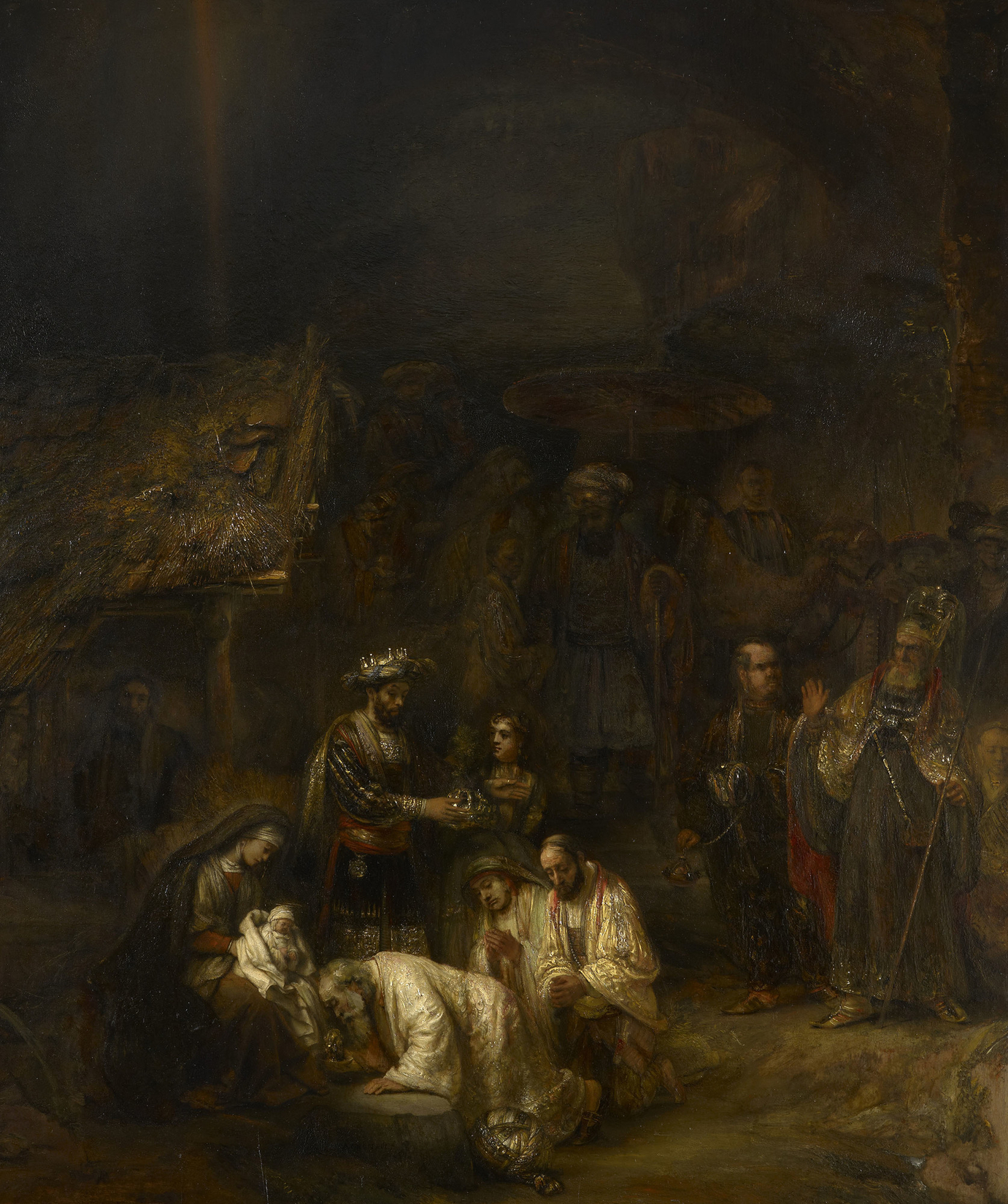
The Feast of the Epiphany of Our Lord
Bulletin (Long)
‘Behold, wise men from the east came to Jerusalem.’
+INJ+
I remember a quote from my days as an overly self-satisfied college pseudo-intellectual: ‘If you gaze long into the abyss, the abyss gazes also into you.’
A line by the German Philosopher Friedrich Nietzsche. It has everything that an angsty teenager wants in a one-liner. It sounds deep. It sounds dark. It hints at emotional depth, at moral uncertainty. But most importantly to a young man who thinks he is finally figuring life out for himself, it sounds obscure, like it is hiding a secret meaning that no one can quite figure out. No one, of course, except the person reciting the quote.
Except what I did not realize at the time was that the meaning of the quote is not quite so obscure at all. In fact, it is obvious to anyone who has lived much life. What the philosopher was noting was simply that we all become what we contemplate, even if what we contemplate is nothing at all.
If we gaze upon beautiful works of art, our mind is filled with the lofty feelings of artistry. If we sit quietly and take in the flowing pleasures of Bach or Handel, we are conformed to the freedom of their disciplined music. If our eyes widen before the uncleanness of internet images housed on websites we only search when we are assured of our absolute privacy, we are defiled, and become incapable of anything like true love.
Every mother knows this, and for this reason tries long, and for perhaps too long, to hide their child from every ugly fact of life, knowing that seeing too much of the world’s ugliness too young will in fact make their child’s mind a monstrosity.
So what then is the contemplation of your mind?
It may sound like an accusation, but it would not be much of one, for I am assured that the occupation of your mind is much the same as nearly everyone else’s. Like the compound eye of a fly, we are always inspecting any number of things. We look at our bank account, we worry about our finances, we glance sideways at our kid’s bad behavior, we roll our eyes at our spouse’s slowly developing bad looks, we wince in shame at our own rapidly wrinkling face and broadening waste line.
We distract ourselves from these unpleasant things by thinking of practical things, necessities, the daily needs of life that always and ever overwhelm us: we need to buy food, we need to fill the tank, we need to catch the game, we need to call our parents, we need to feed the pet; we need, we need.
By contemplating so many little things, we become conformed to them, fragmented within our mind, unable to focus, unable to see any particular thing as important. In any given moment we go from being a pinnacle of Christian piety as we rush the kids to church, then a moment later the pit of hell’s wrath as the car before won’t keep up with the speed limit. We conform to everything that is right before us that commands our attention, and we never stay that one thing for very long, for soon we will bend to the next object of our minds eye, because in that moment, it will seem ever so important.
Yet perhaps it is not true that in becoming all these things, we become scattered. In reality, though we may think we are first looking upon this, then that; contemplating this concern, then that problem; in reality, we are always simply contemplating ourselves, our problems, our lives, our desires, and lusts, just through the lens of so many, many things, like the compound eye of a fly.
This fact, that we are ever focused on ourselves, is exactly how St. Augustine once defined what underlies all sin, as being incurvatus in se: ‘bent in on oneself.’ Always, and ever, beholding in, in—in—as if something within is worth beholding.
The philosopher’s quote is interesting, and obvious, but not quite to the point, since no one is much at risk of gazing into the abyss. What we all do, what is always true, is that we are forever gazing into a mirror.
There is another quote, like unto the first: ‘Who can look into a mirror without becoming evil? The mirror does not reflect the evil; it creates it.’ In some sense, a most Christian observation, and one which every teenage girl taking a selfie knows. We are by nature sinful and unclean, and in that sinfulness, we become our own object of contemplation, and in so contemplating ourselves, we become ourselves more, we become more sinful, more unclean. This is what Luther meant when he said our hearts are a factory of idols: from within ourselves, we create objects of our own worship; we bow down and kneel in adoration before this or that aspect of our own egotism, and in so doing, succeed in becoming our own god, and a false one at that.
The Magi approach Jerusalem, the city of David. They are seeking something, and they are not sure what. They do not want to contemplate the constantly changing problems of life, for they do not want to become restless, so they look for something unchanging. They do not want to contemplate the writhing hell of their own belly, for they do not want to become hellish, so they look away from themselves… far, far away.
They look to the heavens, to the stars, to the swirling sphere of unchanging lights, the only thing constant in a disturbed world; the only thing bright in the midst of the darkness.
One cannot blame them for choosing such a path, and yet it is not an easy path for them to have chosen. For in the sky they have seen a star. And abandoning all, at great expense, they followed it, much as Abraham hearing the call of God to go to a land to the West.
They followed this star, and it has led them to a place; a bad place, that is, the court of king Herod. He is a paranoid king, a murderer, power hungry, and insecure. But guided by the changeless heavens, guided by this new star, they enter this court, and speak to this king.
‘Where is he who has been born king of the Jews? For we saw his star when it rose and have come to worship him.’
‘When Herod the king heard this, he was troubled, and all Jerusalem with him.’
Indeed, they should be troubled, for in a world where selfishness is the only constant, and all else is nothing but flux and tide and torrent, a new thing, that never changes, is a change unheard of, and unbearable…
King Herod summons the Magi, for he seeks to destroy the newborn king. Indeed, we all know from our own lives that anything that distracts from the idol in our soul must be destroyed.
The Magi go their way, and seek out the meaning of the star. As the star remains unchanging, so they become ever more resolved to discern its import.
But the unchanging heavens, and this unchanging star guides them to what seems least constant, weakest, frailest, and most at risk of dissipating in an instant: they saw the child with Mary, his mother.
I do not know what they thought when they saw the child, our Lord, nor what they saw when they saw His mother, little more than a girl. But they fell down, and adored him, a response which, if you read the story honestly, seems to make very little sense. Why would such rich, wise men, be bending down before this baby, and this girl? Why would they present Him with gifts: gold, frankincense, and myrrh?
But they fell down, and adored him. And they could not have done otherwise, and I will tell you why.
You become what you contemplate, and in that moment, so did they, for it is written:
‘God is love.’
+INJ+
Preached by Pastor Fields
Sermon Texts: Isaiah 60:1-6; Ephesians 3:1-12; Matthew 2:1-12.