
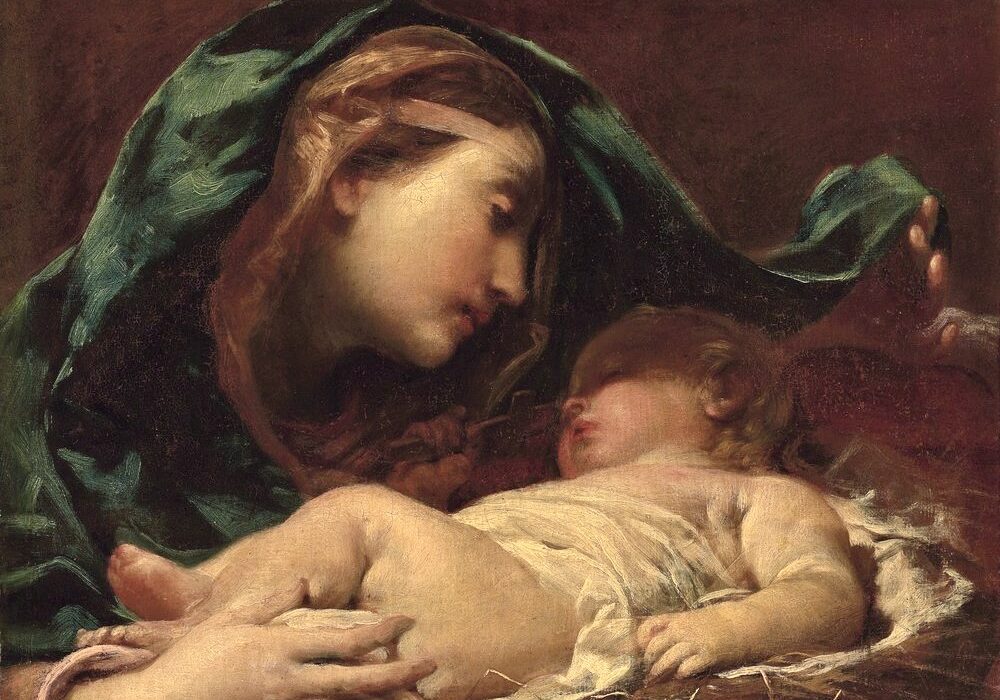
The Feast of the Nativity of Our Lord
‘And the word became flesh, and dwelt among us.’
+INJ+
If there is any one emotion that typifies our hymns and songs that we sing during the seasons of Advent and Christmas, it is ‘joy.’
‘O joyful carols let us sing, on Christmas day in the morning.’ And ‘Joy to the world, the Lord is come.’ ‘Rejoice, rejoice! Emmanuel has come to thee, O Israel.’
This makes sense. What could be more appropriate to this day than a joyful heart? Christ is born of a virgin and placed in a manger; the king has come; the dwelling place of God is with men; he has spoken to us by his son.
Not only does the coming of Christ kindle gladness and happiness in our hearts, but there are Christmas trees and Christmas lights and stockings and gift-giving, and dinners and things, lots and lots of things, that we give to others, and more importantly, that they give to us. And what is a more joyful feeling than the feeling of getting things?
If one is waiting for me to rage against the commercialization and materialism of modern Christmas culture, they will be waiting long indeed. I love everything about American Christmas, in all its gaudy, kitsch, garish hilarity.
Besides, it would be a betrayal of our shared Lutheran faith for me to attack the now-well-accepted customs of Christmas. It was us Lutherans that introduced most of them to the world. Christmas trees and garlands and Advent wreaths and St. Nicholas; candy in shoes and candles on heads and pregnant presents patiently pleading for us to shake them. If one ever reads A Christmas Carol by Charles Dickens, one may notice almost all of these traditions being totally absent, and the ones that are present being depicted as ‘novelties’ in English society; a novelty introduced by the Germans.
Perhaps it is true that joy is what fills the Christmas season. Especially for children, the joy of Christmas is not only palpable, but a palpitation. They can neither sleep nor focus nor think of anything the day before Christmas, so filled with excitement are they.
Yet as one grows older, the feeling that dominates the Christmas season becomes less and less joy, and more and more something else: nostalgia. Nostalgia literally means ‘the pain of homecoming.’ Rather it is not the pain of coming home, but the pain of never being able to go home. We long for the Christmas we used to have, with all the good feelings and merry making we remember from our youth; feelings that seem to elude us more and more as we become older, wiser, more jaded, more calloused.
If ‘joy’ is one of the great virtues that typifies the Christian life, Christmas or not, nostalgia is the emotion that typifies the entire spirit of the Church. The feeling that we have lost something we once had, a home, a place where we belonged, a place where everything made sense; a place that we cannot return to. We call that place ‘the Garden,’ and our loss of it, we refer to as ‘the Fall.’
***
The ancient Christians rarely thought of the Incarnation of Christ and His entering into the world as a time of joy. Rather, they called it something else, something that seems almost the exact opposite of a happy occasion. They called it His humiliation.
We celebrate the birth of Jesus because we view it as the beginning of our restoration to paradise, the first phase in the undoing of the Fall and our return to our first home, the Garden of Eden; we view it as the end of our nostalgia, and the start of our long-awaited journey home.
But for Jesus, the very Son of God, it is nothing but a descent, an exodus from His home in heaven, a forsaking of father and mother and brothers and sisters.
There is a poem entitled Gloria in Profundis, a play on Gloria in excelsis Deo: ‘Glory to God in the lowest.’
In it, the poet describes how all mankind seeks after what is above, what elevates our spirits, what exalts the well-lived life. Yet in the midst of all this striving for what is above us,
‘There has fallen on earth for a token
A god too great for the sky.
He has burst out of all things and broken
The bounds of eternity:
Into time and the terminal land
He has strayed like a thief or a lover,
For the wine of the world brims over,
Its splendour is spilt on the sand.’
The glory of mankind, which is the living God, and His image, is no longer contained in heaven above, that heaven and paradise for which we long; rather it has crashed in the deserts of the Middle East, crowded in the little body of the Virgin Mary, barely a home fitting for a king, much less a God, who himself has no home, and dwells in a manger.
The poem continues:
‘Outrushing the fall of man
Is the height of the fall of God.’
Indeed, the Incarnation and Nativity of our Lord is a fall, and not merely a fall from a perfect world to an imperfect one; from innocence into sin. Rather it is a fall from all the infinite glory and beatitude of the eternal God to the wretchedness of our created evil.
Our Gospel reading makes this very clear: In the beginning was the Word, and the Word was with God, and the Word was God. The original blessedness of Jesus is explained in the most profound way. But then it is written: the Word became flesh and dwelt among us. The Lord took on everything that we ourselves destroyed by our sin, our flesh, our world, our exile, our Fall. He is born of a peasant woman in a peasant’s cave with peasant animals. And if His birth seems inauspicious, His life will prove only more so, for indeed, far from merely having no home, the Son of Man will have no place to lay his head.
In His being born a child, He has abrogated all rights of His divine nature. Like us, He will learn to crawl; He will learn to walk; like us He will learn to speak, first by babbling, then muttering, then stringing this word to that. He will be nursed from a breast, only later to gnaw at mottled bread. He is become like us in every way, save without sin.
The Fall of God; this is what we celebrate this day. But it is not a fall like unto ours. For we fell from an earthly paradise to a mortal coil; He fell from the abode of angels to what may be called the left-hand of Satan, the kingdom of the devil, and sin, and unbelief.
His fall is not like ours; for we fell from the garden that we might glorify ourselves. But do you not know that on Christmas, a gift must be given to be received? It cannot be taken. Those who shake the presents before Christmas day, or open them when they ought not, are given coal—a symbol of the hellfire that impatient children deserve for their impatience.
We may not glorify ourselves, but our God fell that He might glorify us in His humility. He fell to us that we who know only sorrow in the valley of the shadow of death, might know joy, and rejoice forevermore. He fell that we who are fallen from our first home might no longer feel our nostalgia, for no longer will we long for a home we can no longer return to; for a mansion is being prepared for us in heaven, and in it are many rooms.
Our Lord now is homeless, and far from home. But see now the Christ child, how He, like any newborn, reaches out to hold your finger. From the poverty of the manger He grabs awkwardly and tightly the tip of your pinky. It may seem to hold onto you for dear life; but the in reality He holds your hand, that He might finally guide you home, O lost and forgotten child, for it written:
‘A little child shall lead them.’
+INJ+
Preached by Pastor Fields
Sermon Texts: Isaiah 52:7-10; Hebrews 1:1-12; John 1:1-18.