
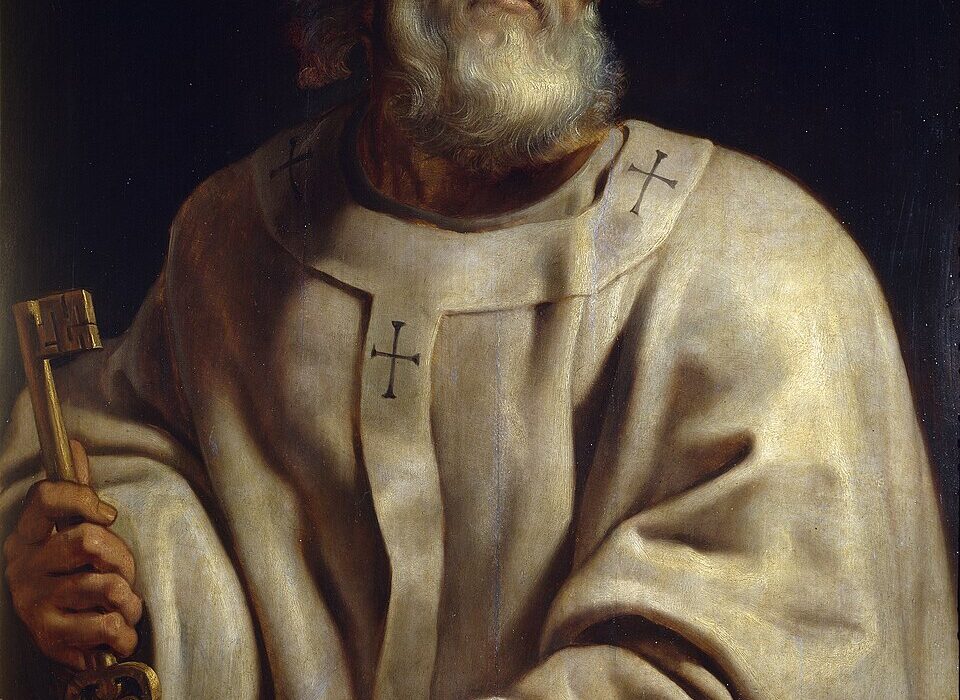
The Feast of the Confession of St. Peter
‘Peter answered him, “You are the Christ.” And he strictly charged them to tell no one about him.’
+INJ+
‘Who do people say that I am?’ Jesus asks St. Peter this question, a question that scholars and thinkers and philosophers of history have attempted to answer in various ways for centuries.
Peter expresses to the Lord the various opinions floating around at the time. ‘Some say John the Baptist, and others Elijah, and others, one of the prophets.’ The people are all sure that Jesus is something interesting. Most even seem convinced that He is something great, something like a man of God, a prophet, a miracle worker, a bringer of the end times. They are not quite sure what He is, but He is something like that.
Today, people give their own answers: Jesus was a great moral teacher. Jesus was a wandering preacher. Jesus was a revolutionary, a political reformer, a proponent of radical egalitarianism, of socialism, of liberation.
Some among the more impious say that the Lord was a maniac, a crazy person; or otherwise He was a criminal fraud; or a proliferator of indecency.
All such answers attempt to do the same thing, and in so doing, fall into the same pit. They all seek to fit our Lord into some pre-existing category of people, something we already know about, are familiar with, are comfortable with; to make Him not unique, but as St. Peter mentions, merely one of the prophets.
When we say, ‘He was a…’ we are attempting to make Him just one of the many. We are always adding to our statement something along the lines of ‘among others.
‘He was a great moral teacher, among others, like Buddha and Confucius.’ ‘He was a revolutionary, among others, like Vladimir Lenin and Che Guevara.’ ‘He was a crazy person, among others, like the Mad Hatter, or Ralph Nader.’
The failure of men, both then and now, to recognize the Christ lies in exactly this, that Jesus will not be known as merely one among others. He is not merely the latest iteration of an old concept, or the next link in the chain of a long line of this’ or that’s. He is something else entirely. And whatever else He is, He is that thing alone, and all alone.
The reality is that the question that Jesus had asked first is unimportant, though we spend too much time talking about it. ‘Who do people say that I am?’
It does not matter what other people say. It never did. The only question that is put toward us is the very question He then asks St. Peter: ‘Who do you say that I am?’
‘You are the Christ.’
It is easy for us to say that Peter simply gave the right answer after recounting all the wrong answers others have given, and that for this reason, he is recognized as a great saint.
But his answer is, in some sense, not very good at all.
No one knew who the Christ was, what He was supposed to do, or where He was going. The Messiah is mentioned in the prophets time and again in vague passages and through allusions and images and metaphors; many that seem contradictory, impossible to grasp, and dark. For St. Peter to say that Jesus is the Christ seems to be saying little more than, ‘I don’t know who you are, but whatever you are, you are something utterly different.’
And yet, that is why it is the right answer to the question. St. Peter cannot truly know what the meaning of his answer is, what it means to be the Christ. Yet what he confesses here is the utter uniqueness of the Lord, that whatever He is, He is alone, and there is none like unto Him. There is no other.
Now Jesus speaks to His disciples, and tells them about this Christ, this one that Peter confesses Him to be, that he must suffer many things and be rejected by the elders and the chief priests and the scribes and be killed, and after three days rise again.
It is here that a most strange thing happens.
St. Peter grabs the Lord and takes Him aside. He rebukes Jesus for what He is saying. ‘How dare you tell us that you are going to be killed? Don’t you see that we have left everything to follow You? We used to be respectable people, at least all of us but Matthew. We were hardworking, came from good families, married loving wives, respected in our communities. But we forsook all these things to follow You, because we knew You were something different. But now You are telling us You are just going to go off and die? You cannot leave us like that. You cannot abandon us like sheep without a shepherd. Or if You are just speaking out of fear, that You are afraid that someone will come kill You, don’t be. We’ll protect You. I will protect You. Just don’t say such things like that.’
It is here that we usually recall that Jesus retorts: ‘Get behind me, Satan.’
But in so remembering this passage, we forget the strange thing.
It is first written: ‘but turning and seeing his disciples, Jesus said to Peter.’
Why does Jesus look at His disciples before responding to St. Peter? And what is He thinking? What is it about looking at His disciples that causes Jesus to then turn and attack Peter, ‘get behind me Satan!’
Indeed, Peter here is Satan. For recall Christ’s forty days in the wilderness, how He sat hungry, and alone. The devil comes to Him, and tempts Him, first to turn stones into bread, then to leap off the temple walls, then to merely show gratitude to Satan, and so receive all the kingdoms of the earth. In each case, the devil tempts the Lord in the same way: ‘Do not follow the way set forth by your Father, for that way leads to suffering and pain and death. Why suffer? If you but show me the respect I deserve as the most beautiful of the angels, and the most beautiful of your very own creations, then I will give you everything that you came here to get, but unlike your Father, I will give it to you without the shedding of a drop of blood. Can’t you see? All I ever wanted was for you to love me like you loved Adam. Just love me, dear Son of God, and I will give this world to you, and give it to you without the Passion.’
It was the devil who first promised the Lord glory apart from suffering. And now Peter does the same, for indeed, in this moment, he has become the devil, even in allowing his love of Jesus prevent Him from bearing His cross.
We should not think that these temptations are without their power. We know that Jesus, as bone of our bone and flesh of our flesh, and sharing in our very nature, does not want to die. He even prays that if it be possible, that the cup of suffering part from him. We know that He will sweat blood and tears as He approaches His execution.
When St. Peter promises to defend Jesus, Christ is no less tempted than when Satan offers the world to Him. It is a fine deal: all the world, and for free: the best price.
But Jesus looks to His disciples. What is He thinking? I think it is no different than what He thought when He looked upon the rich young ruler.
‘And seeing him, he loved him.’
The Lord must undergo His Passion. The Lord must face His death. Having taken on the sins of the world; having taken on the sins of His disciples, His friends, in the waters of the Jordan, in His baptism by John, He must now carry those sins to the Zion, to Golgotha, that upon the tree, He must forever hang them, that He might bear the curse, and have sin crucified within His very flesh, that those who believe in Him might be set free, for without the shedding of blood, there is no forgiveness.
He must go to the cross. He must be put to death. And He, He alone, can do this; for He alone is the Lamb of God. He alone was washed in the Jordan. He alone is the sin-bearer. He alone has lifted up the whole city of our iniquity upon His back. And what He must do, He must do alone, for there is none like unto him, and there is no other.
‘You are not setting your mind on the things of God, but on the things of man.’ It is the thing of man to want to live; perhaps it is the thing of man to want to live forever. And St. Peter surely wants our Lord to live. But it is the thing of God to want to live forever in the presence of the Lord, and to be bathed in the radiant light of His love eternally.
Yet no sinful man may stand before the throne of God, and live. And so the sacrifice must be made.
Christ does not want to live. He wants to live with His friends. It is as simple as that. He does not want to be alone; yet if His disciples are to live with Him forever before the face of the Father, He must now go and die alone.
I mentioned before, in a previous sermon, the quote, ‘If you look long into the abyss, the abyss looks back.’ Every Sunday, in the celebration of the Lord’s Supper, during each part of the consecration, I raise up first the bread, then the wine, in the so-called ‘elevation.’ This is done for two reasons; it is so that the people in the congregation can see the elements that have now become the body and blood of Christ, and more importantly see that this very same body and blood that we are soon to eat and drink have ascended into heaven, to forever plead for our forgiveness before the mercy-seat of the Father who is in heaven.
Look upon the body and blood, I pray, when they are lifted up. Look upon them, when your pastor turns around and displays them to you, calling out ‘the peace of the Lord be with you always.’ Look upon them long, and you will know that they also look back, even as Christ turned before St. Peter, and saw His disciples,
‘And loved them.’
+INJ+
Preached by Pastor Fields
Sermon Texts: Acts 4:8-13; 2 Peter 1:1-15; Mark 8:27-35.