
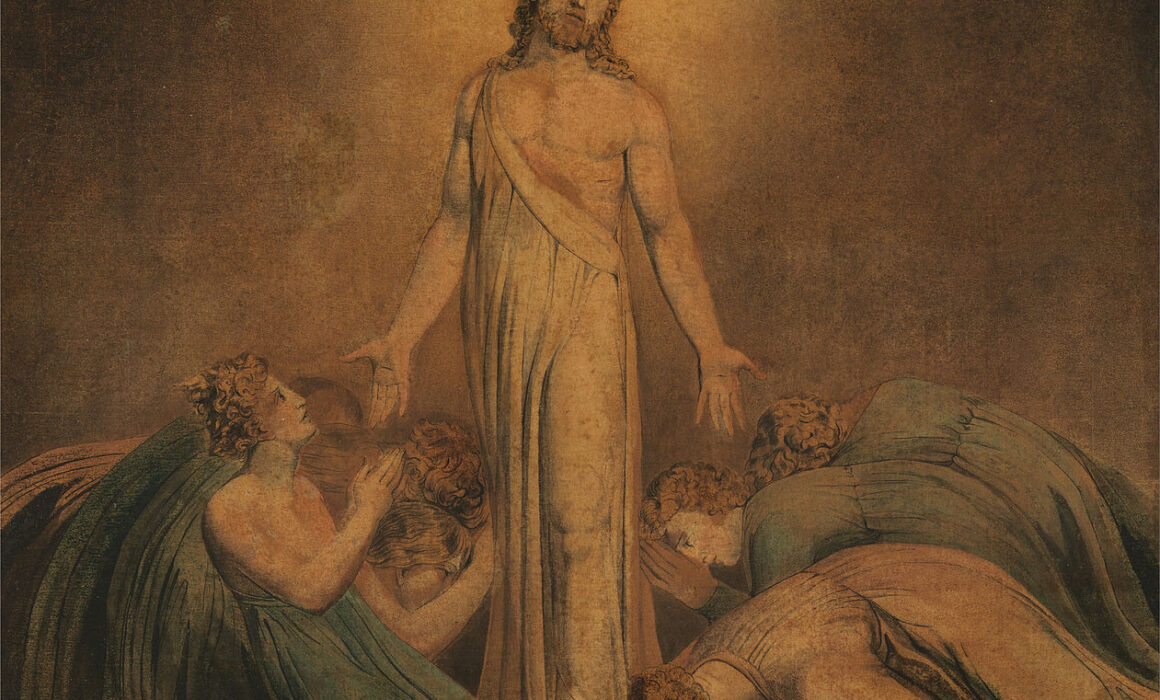
Sermon for the Twenty-Third Sunday after Pentecost
‘The days will come when there will not be left here one stone upon another that will not be thrown down.’
+INJ+
The Gospel reading begins: ‘And while some were speaking of the temple, how it was adorned with noble stones and offerings, he said.’ Those speaking are the disciples, and, as they are prone to do, they are remarking on the famously massive stones with which the Temple in Jerusalem was built, as well as the so-called ‘gifts’ or ‘offerings’ with which it is adorned.
Yet it is hard to understand exactly what they are talking about if you do not first notice that our reading begins with the simple word ‘and.’ ‘And’ implies that what is happening now is connected to something that happened before; something that the wise men and sages of the Three-Year Revised Common Lectionary[1] chose not to include for us in today’s pericope.
What immediately precedes today’s Gospel text is the story of the so-called Widow’s Mite, where a poor woman offers her last two pennies as a gift to the Temple, winning the praise of the Lord, who commends her for having offered ‘all she had to live on.’
So now we can understand what it is that the disciples are discussing. They were feeling quite pious, perhaps ruminating upon Jesus’ accolades for the old lady. ‘They were speaking of the temple, how it was adorned with noble stones and offerings.’ Perhaps they were speaking about how, even though the Temple was composed of the most impressive hewn stones that one might ever see, with its interior bedecked with gold ornaments and fixtures and precious tapestries and incense, yet the true adornment of the House of God was not in such mighty bulwarks and finery, but in the humble, selfless donations of the meek and weary.
It would be a good observation for them to make, a Christian one even. One that might even form the basis of a good Sunday sermon on the Lord’s love of the lowly, or on self-sacrifice, or on stewardship of the Church.
It is with this in mind, the holy conversation of the disciples on the loving gift of the wretched widow, that we begin to understand our Lord’s strange response.
He does not say, ‘You have understood well that the kingdom of God belongs not to kings who build great buildings made of stone, but to the poor in spirit.’ Nor does He go on to tell some parable to the effect that the meek shall inherit the earth. Rather, the Lord speaks:
‘The days will come when there will not be left here one stone upon another that will not be thrown down.’
After having praised the widow, the Christ seems to chide His disciples for doing the same. ‘Her gift to the temple is empty, meaningless, for both the temple and her gift will soon be destroyed.’ Not one stone will be left upon another.
He is not wrong. For the days would be drawing near when the Romans, seeking revenge for the gall of the Jews who sought to rebel against their rule, would bring siege against the city of Jerusalem, and would break down its walls, and slaughter its inhabitants, scattering its few survivors throughout the Empire, and far off into Persia and India, and would wipe out the Temple, leaving not one stone upon another, the structure that to this day has never been rebuilt.
This would not be the first time the Temple of Jerusalem had been destroyed. Yet after it had been destroyed in Israel’s past, it would be rebuilt. Yet it would seem that this time it would remain a waste forever.
Even today, those who remain faithful to the teachings of the scribes and Pharisees go to the pediment, the foundation of the wreckage of the temple, and weep, at the so-called ‘Wailing Wall.’ They weep, for they do not know that the Temple has yet already been rebuilt.
For God ordained the destruction of the first Temple at the hands of the Nebuchadnezzar as a punishment for Israel’s idolatry. But He allowed the destruction of the Second Temple for a simple reason: it had served its purpose, it had done its time. For no longer would God dwell in this temple made with hands, nor rule from within its great rock. Rather, a new temple has been prepared, one born of the flesh of the Blessed Virgin Mary, the temple of Christ’s body, where God would be pleased to dwell as one person unto the ages of ages, the world without end.
This temple, no man may destroy, nor the devil nor all the world. For destroy this temple, and in three days I shall raise it up. Indeed, nations rose up, and wars and rumors of war filled the hearts of men, as they took counsel together against the Lord, and against His anointed, saying ‘Let us break His bands asunder.’ They crucified the Lord of Glory, with earthquake and great terrors and signs in the heavens, where even the sun was blotted out. Indeed the nations will be distressed with perplexity, and the people fainting with fear and foreboding, as it is written: ‘All of Jerusalem was greatly troubled.’
And yet in three days, the sign of Jonah came to pass, and death spat out life upon the shores of this world, for the grave was opened, and the true Temple, our Lord Christ, rose from death and hell, that it might be fulfilled, ‘your redemption is drawing near.’
Now the mystery of Christ is revealed, for it is written, the stone that the builders rejected has become the corner stone; and so the Temple of Christ’s body, having been sown into the earth, remains not alone, but has become the corner stone, the keystone, of an even greater temple. It has become the foundation and stronghold of the Temple of the Church, which is the body of Christ, and of all Christians who have been baptized into the Lord’s death and resurrection, who by the waters of the font have received the Holy Spirit who dwells within them, ever praying for their forgiveness, even when their soul is too burdened with sin to plead for itself. For by the Holy Eucharist, we become participants in the flesh of Jesus, in the new and last Temple, and of the divine nature.
So St. Peter tells us when he writes, ‘Ye also, as living stones, are being built up a spiritual temple, a holy priesthood, to offer up spiritual sacrifices, pleasing to God by Christ Jesus.’
Now the Church and every Christian is not a temple built of carved stone, but of words, every revelation and promise of God, by which the fortress of Christ’s body is completed. Every scripture, and its ‘carefully understood meaning’ is now the gift that adorns this new temple, crafted by the Holy Prophets, by whom God speaks, who are to the Church its architects and masons and laborers.
Today, this temple again is adorned by a gift from the God who became poor for our sake. It is built again by faith born of the Word of God, for today we confirm and seal the gift of the Spirit in two more who are among us, who you may have met already, and who you can surely meet again over cake in but a short time. Now Zach and Hudson are become the temple, for this day they will eat and drink of Christ’s body and blood, and so be woven into the eternal house of God in the forgiveness of sin.
Hudson has chosen to take on a Christian name, a Eucharistic name, to celebrate his first Communion as a member of Christ; an ancient custom to dedicate to oneself a pattern of life from among the saints to be a guide during his days of pilgrimage upon this earth. He has chosen the example of St. Sebastian, a martyr of the early Church, who was said to have preached the Gospel to a noble woman named Zoe who had become mute, who upon her baptism had her speech given back to her. Indeed, if the stones of the Church are the words of God, then St. Sebastian shows us that by the preaching of this word, another stone is added, and that stone too becomes a speaking stone, clothed again in words.
And yet St. Sebastian was a martyr. He was killed, and the temple of his body was destroyed by an unpleasant combination of arrows and clubbing. It had to be that way.
Do you think that the nations no longer rage and the heathen no longer imagine a vain thing against the Temple of God? Do they no longer plot in the dark, that they may leave not one stone upon another? The Church is always besieged. It is always being destroyed. Even today around the world Christians are murdered from without. Even in this sanctuary, the chapels within our hearts are desecrated with pagan idols. To be confirmed in the faith, and to be sealed in the Spirit, to be joined to Christ’s life, is it not to be conformed to the suffering and death of the Lord?
The rage of the nations, and the bloodlust of the demons is the proud inheritance of all who have renounced the devil, and all of his works, and all of his ways. And yet even if this Temple be destroyed in us, yet the cornerstone, who is Christ, always remains, and by the word of the Prophets, the preaching of the Gospel, and the power of God, it is yet always raised and built anew, even on the third day.
Doubt fills our minds, our zeal grows cold, our interest wains, the cares of the world overpower us, but the Lord Christ remains constant, the same yesterday, today, and forever, and the temple of His body, which is the mystical Church, is always and ever raised from hell. For He alone is from everlasting to everlasting, and not one his flock will be taken from him. No evil will befall you, nor plague come nigh thy dwelling. For many are the afflictions of the righteous, but the LORD delivers them out of them all.
So do not fear, dear Christians, when distress fills the earth, and the nations are perplexed, when the sea and the waves rage, and even the powers of heaven be shaken, for when these things take place, you will know:
‘The hour of your redemption is drawing near.’
+INJ+
Preached by Pastor Fields
Sermon Texts: Malachi 4:1-6; 2 Thessalonians 3:6-13; Luke 21:5-36.
[1] The Three Year Revised Common Lectionary, which our congregation uses, is the cycle of readings which has its origins in the 1969 Ordo Lectionem Missae. The exact selection of what the readings are, though based on Medieval monastic lectionaries, were often the product of higher-critical studies and committee compromises, and so sometimes the readings exclude verses that are necessary to understanding the whole text.