
Sermon for the Exaltation of the Holy Cross
‘Where is the one that is wise?’
+INJ+
It is an honest question, where is the one that is wise?
The history of mankind can be understood in many ways. Among the ancient pagans and medieval clergy, it was largely viewed as a tragedy; a relentless cycle of ambition, hubris, lust, and pride leading to endless bloodletting, slavery, and oppression.
Among the more modern spirits, starting with the Renaissance and continuing to our time, it is viewed with a sort of hopeful triumphalism, a certain scientific perversion of the Christian doctrine of Passion and Resurrection; that if we struggle enough in our own time, we will certainly usher in a paradisical future, free from want and sorrow; what the eloquent William F. Buckley somewhat snidely referred to as ‘immanentizing the eschaton,’ making our future heavenly end happen here and now, ideally right now.
It is a much more hopeful view of our existence compared to what our antiquated forefathers would have held. Yet it is no less ambitious, hubristic, lustful, and prideful. It is nothing but another repetition of the mind of Babel, that we can build a tower to heaven and dwell with God by our own effort, if only we are of one mind and one accord, if only we apply our knowledge, our wisdom, our enlightenment diligently.
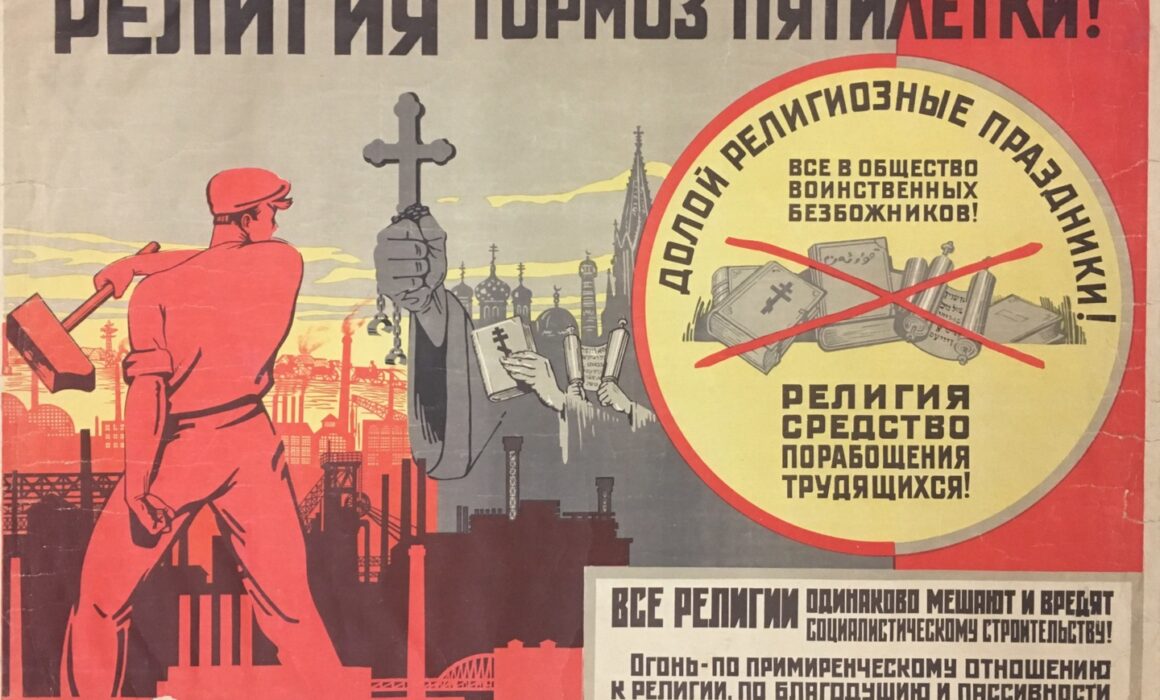
No nation on the earth has so whole-heartedly and purely sought to ‘immanentize the eschaton,’ to bring about an earthly paradise, than the Russian people.
Russia is much in the news these days, as a sort of evil empire. And so I will tell you a tale of Russia, when it was most evil.
There were once many Lutherans in Russia, millions; that is, until the first and Great Purge of Stalin, who put to death about five thousand Lutheran priests, and exiled the laity of the Lutheran church to Siberia.
This was during the reign of the Soviet Union, when everything beautiful of that ancient nation was replaced with concrete and uranium and hope.
When the Soviet Union fell, a professor of one of our seminaries was sent to Siberia to seek out what Lutherans might remain there, and to serve them.
He in fact found many Lutherans still there, in Siberia. They had maintained their faith for eighty years, baptized by laymen, as they had no pastors.
To them he brought communion, a gaggle of men and women, old and young, in a small wooden shed that they gathered in and called their church, though there was no sign on it to say it was, since it was illegal.
He fed them the body and blood of Christ, saying as we are used to hearing from any pastor ‘the body of Christ, given for you; the blood of Christ, given for you.’ As he spoke, those standing before Him mouthed the same words in Russian. They mouthed them in tears, barely able to stand.
It was then and only then that he realized the obvious: that this was their first communion; grey-haired old women, and bald broken men were greeting their Lord in person for the first time; and the Words of Institution that they mumbled softly under their breath, they knew not from hearing it week after week from a pastor’s lips, as they had none, but from the Small Catechism, which was preserved from memory and passed on from generation to generation. So they ate the body of Christ, and drank His blood; this food, for which they had waited all their lives, in a land of concrete, and uranium, and hope.
This was to fulfill what was written: ‘I waited patiently for the Lord, he inclined to me and heard my cry.’
According to the ancient custom, a custom that none of them had ever practiced before, they made upon themselves the sign of the cross after receiving first the body, then the chalice.
The cross they put upon themselves. When the empire that was to usher in the end of history had ended, when the hammer and sickle had ceased to wave, the cross remained. The flag that promised bread for all was starved and fallen. But now the Christ, whose kingdom will have no end, gave His flesh to eat.
The Red standard has fallen. But do not be deceived. This is not a heroic victory of freedom over servitude, nor of capitalism over communism, as many then and now pronounced. For nothing that the scheming of man shall devise will last, nor shall his desire be fulfilled on this earth, much less through the princes of this world.
For as much as I am sure we all love our own country, these United States, and swell with pride upon hearing our anthem and saluting our flag, ‘this too shall pass’; this nation will end, its ambitions will be frustrated, its ideals desecrated and abandoned, its yearnings forgotten by men who are so want to forget. If the dream of a scientific society liberated from inequality would so quickly collapse, so too will an idealistic nation liberated from all servitude and oppression, a ‘land of the free’; our prudence and sophistication will come to nothing, for it is nothing more than a creation of mortal men. The tower shall not be built, but we will indeed one day be scattered.
For it is written, ‘I will destroy the wisdom of the wise, and the discernment of the discerning I will thwart.’
On that day, it will very much be said, an honest question, ‘where is the one that is wise?’
But the cross shall remain, a stumbling block to the Jew, and foolishness to the gentiles: The cross shall remain, for it pleased God through the folly of what we preach to save those who believe. The cross shall remain, perhaps on the flags of nations; perhaps in the halls of churches; perhaps hanging in the entryways and living rooms of Christian homes; but always imprinted invisibly and forever upon the forehead and heart of every baptized body; the sacred temple of the Spirit when all that is sacred it cast away.
This banner waved invisibly on hundreds of thousands of Russian exiles, just years after the Red hammer ceased to be waved anywhere in the vast domain of the Soviet.
This banner, this imprint, this vision, is the Holy Cross, and it shall outlast all things; every ruler and king and dictator and president; every nation and empire and utopia; it shall outlast the earth and the stars. Nothing will overcome it. For the Holy Cross is the emblem of the reign of Christ, whose kingdom will have no end.
For He, and He alone, with the Father and the Spirit, eternally one, is God, who has no beginning nor end, as His kingdom has no beginning or end; as His Gospel has no beginning nor end; as His Passion has no beginning nor end; and thus His Cross has no beginning nor end.
So we make the sign of the cross upon ourselves, not just to mark ourselves as ones baptized, though this is true, but to show our citizenship to the imperium sine fine, the empire without end, the rule of our Lord Christ, who is as a Lamb slain upon an altar, and to whom crowns of kings are thrown.
When the Son was slain, it was written, “Behold, the king of the Jews.” The Jews demanded that the inscription be changed, but the gentile ruler rightly declared, “What I have written, I have written.” For He would forever be the king of the children of Abraham, and of all those who would be made children from rocks cast on the road. And this again written upon the cross.
We fear in our age that the time of the Church is coming to an end, that modernism, postmodernism, materialism, scientism, that these are all exterminating the old ways of Christ. We anxiously look at polls of how many Americans call themselves Christians, and with worry look at how God is pushed out of the public sphere.
But God is pushed out of nowhere, for He is a God who hides himself. We worry and fear where He does not, for we do not live very long, and so a short time seems long to us. We too become impatient upon the way.
Foolish Christians, do you not know that the sign of the cross placed upon you in baptism will cover even your coffin? Do you not know that when you close your eyes for the last time to this sinful world, you will open them to the Holy Cross, in the world without end?
Everything shall pass, everything, but the Holy Cross, carved upon your forehead, and upon your heart, for He was crucified before the foundation of the world. The symbol of the eternal kingdom of God, everywhere and always present, made immortal in the resurrection of the flesh, which shall be raised in the last day, to enjoy the vision of Christ your God forever, that cross was, and is, and ever shall be. Therefore, do not grumble, but be patient.
When the name God and of Christ has been banished from every public airway and civic building, when to confess Him invites only mockery and trial and prison, when the Eternal One is thought to be nothing but a superstition of a past ignorant age, when Satan reaches out to grip all the kingdoms of the world as his own… then will a rip in the sky open up, ever so slightly, and the silhouette of one like a son of man, pass through as through the eye of a needle. And perhaps you will lift up your eyes, and see; and say with the old lady in Siberia, with a tear in your eye:
‘I have waited patiently for the Lord.’
+INJ+
Preached by Pastor Fields
Sermon Texts: Numbers 21:4-9; Psalm 40:1-11; 1 Corinthians 1:18-25; John 12:2-33.