
The Fifteenth Sunday after Pentecost
‘At that time the disciples came to Jesus, saying, “Who is the greatest in the kingdom of heaven?”’
+INJ+
‘At that time.’ Or more precisely, ‘at that very hour.’
It can seem that the disciples are just quarreling again, jostling for distinction before the Lord who is not a respecter of persons. It is easy for us to criticize the twelve for such petty arguments, but if we recall the words of our Lord from last week, and the week before, we will realize that they are not being so petty after all.
For the week before last, we heard our Lord praise St. Peter, and his glorious confession, that Jesus is the Christ, the son of God. Upon this faith declared by Peter, the eternal Church shall be built. Indeed, it seems that Peter, and his faith, shall be the stone that shall not be cast away, but rather be made the cornerstone of so great an edifice.
But this is thrown into confusion, for last week, Jesus begins to speak again and again about His coming Passion and death. Peter rushes to defend Jesus, and His life, declaring that he will by no means allow this fate to befall our Lord. But for this he is rebuked: ‘Get behind me Satan, for you keep not in mind the things of God, but the things of man.’
So it is that now, the disciples quarrel among themselves. Peter, whom they all considered among themselves to be the first among their lot has been condemned as carnal and human; Jesus, who alone is heavenly and divine among them, has foretold His own death, that soon He will no longer be found in their midst.
They are not merely fighting with one another about who is best for the sake of ego or pride, asking ‘who is greatest in the kingdom?’ Rather, they are pleading with Jesus to instruct them on what must now seem a most pressing issue: ‘Once you are gone, once you die and leave us, who will lead your Church?’ ‘Who will continue your mission of spreading the Gospel?’ ‘Who is greatest in the kingdom?’
We often ask this same question. Too quickly do we look at the Church and view it first and foremost as an earthly organization. Perhaps, as Lutherans, we are quick to condemn our Roman Catholic brethren, for they very explicitly see the Church as first and foremost a divine bureaucracy charged with the equal distribution of merits, penances, and grace. Yet we are no better, when we dispense with our time arguing over this or that referendum of the Synod, or this or that decision by the Voter’s Assembly, or whether a congregation is ultimately led by the Council, the Elders, or the Pastor.
The clergy in our midst fall into this problem, as they pine for the episcopy, that is, a system of church governance ruled by bishops, for they hope that if there was just a little more oversight, perhaps our little American Lutheran communion wouldn’t be such a mess. Surely a little more oversight wouldn’t hurt, and surely it would be a fine feather in our clerical caps to be able to brag with the rest of our Lutheran brothers around the world of obtaining Apostolic Succession.
Even now, among the no small number of new Christians, who knock on the doors of churches, seeking tradition and rituals and eternal truths to deliver them from the listless relativism and meaningless of the secular culture—even they so often seek to find what they can only call ‘the one true Church,’ by which they mean one true tax-exempt recognized religious organization that was originally founded and intended by Christ.
But whether or not this issue of the true church, and its proper administration, is one upon which we should focus, it is still to us an important issue; for we, as those who dwell yet on earth, in this flesh, must know where we are to gather, if we are indeed to gather in the name of Jesus.
It would be quite helpful if, here, our Lord were simply to say, ‘you shall follow the leadership of St. Peter, and his successors,’ much to the joy of the Papists; or if He were to say ‘you will be guided by those who sit on the seat of St. John and St. James and St. Mark,’ to the pleasure of the Orthodox and Coptics. It would be great if He were to say to our own great pleasure, ‘wherever the Word is rightly preached, and the Sacraments properly administered, there I am with you.’
It would be great if the Lord just answered the question, who should we follow? Lord, to whom shall we go?
But this He does not do.
‘Lord, who is greatest?’ Lord, who will lead us?
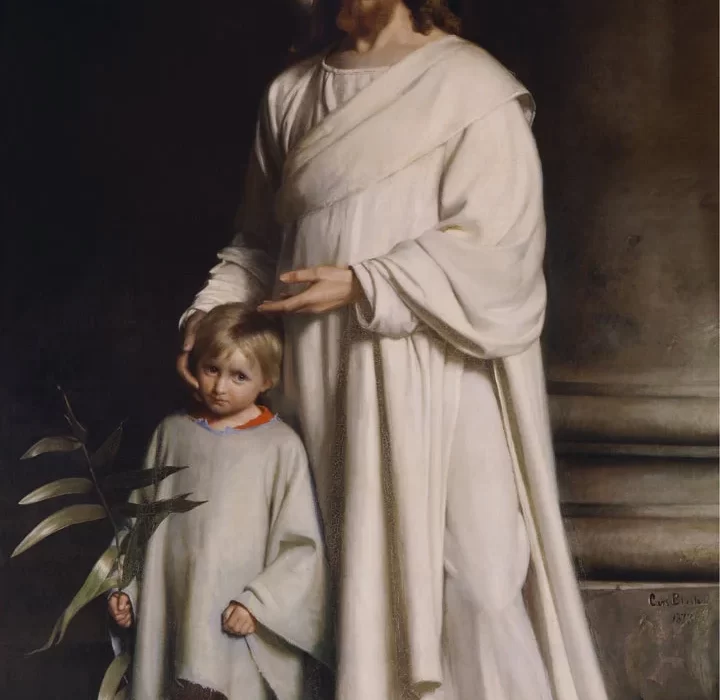
And calling to him a child, he put him in the midst of them and said, “Truly, I say to you, unless you turn and become like children, you will never enter the kingdom of heaven. Whoever humbles himself like this child is the greatest in the kingdom of heaven.
It is a child who is the greatest, and the child that shall enter the kingdom. It is the child who shall then rule the church, for whosoever receives one such child in my name, receives the Lord Christ.
This dark saying of our Lord causes us to immediately wonder, ‘what does it mean to be like children?’
In our sentimentality, our first response is to say that children are innocent, without sin or fault or guile. We are to be like them, imitating their blamelessness. And yet to think this, though seemingly such a kind interpretation, would lead to the most demanding and unflinching result, for all would be required to become without sin and without blemish by their own strength: a task which cannot be accomplished.
Perhaps it is that children are meek, that they do not give resistance, that they are impressionable; but this cannot be the case, for though we must be easily impressed by the likeness of Christ, we must be absolutely steeled against the influence of the devil and the unbelieving world, even as our Lord goes on to say, ‘Woe to the world for temptations to sin! For it is necessary that temptations come, but woe to the one by whom the temptation comes! And if your hand or your foot causes you to sin, cut it off and throw it away. It is better for you to enter life crippled or lame than with two hands or two feet to be thrown into the eternal fire. And if your eye causes you to sin, tear it out and throw it away. It is better for you to enter life with one eye than with two eyes to be thrown into the hell of fire.’
Against temptation, we must offer not an inch. By such things, we cannot be impressed.
It has always been my conviction that what we are to share with the little child is the only thing that the little child is born with: poverty. What most describes a child upon his birth is simply ‘that human that has nothing, but receives everything.’ It is this, this humility, which we are to learn from the child; that we recognize that we who are born of baptism have nothing to render unto God, but from God must receive all that is good; that through the goodness of creation, we receive what is necessary for our body; that through the goodness of the Word and Sacraments, we receive what is necessary for our soul.
And indeed I am still of this conviction, for nothing more properly describes the Christian life than Him who has received from God the life which it so pleased God to give. Indeed, when we hear the readings recited on this day, when we rise from the waters of the font, when we take the Body and Blood of our Lord onto our lips and into our flesh, this very reality we confess, that we are beggars, and that we can do nothing but receive.
We call our church service the Liturgy, for this very reason, for originally, the word ‘liturgy’ referred to the distribution of a rich man’s wealth for the sake of the common people, the poor; and so when we come to church, we receive the wealth of God into the poverty of our nature.
Indeed, the Church has always recognized poverty and humility to be the brute fact of Christian existence. It is for this reason that we used to call the most unworthy and wretched of people among us ‘cretins,’ which is nothing but a degraded English form of the French word ‘chretien,’ meaning a Christian; for when we lack everything, we, in some sense, become most close to Christ.
I still stand by this interpretation of our Lord’s words. But I was somewhat surprised when I read the words of St. Jerome, commenting on this passage.
‘Just as this child whose example I show you’ Jerome writes, ‘ he does not persist in anger, does not long remember injury suffered.’
What defines the child, according to the sacred interpreter, is that, when wronged, he does not remember the wrong; that when he suffers, he quickly replaces the suffering with laughter, as soon as he sees the smiling face of his father and mother. In this sense, he is humble, for in no way does he believe himself to be above being trampled on by others.
It is for this reason that our Lord immediately adds, ‘See that you do not despise one of these little ones. For I tell you that in heaven their angels always see the face of my Father who is in heaven. What do you think? If a man has a hundred sheep, and one of them has gone astray, does he not leave the ninety-nine on the mountains and go in search of the one that went astray? And if he finds it, truly, I say to you, he rejoices over it more than over the ninety-nine that never went astray.’ For in saying this, the Lord describes the true shepherd of His church, not as the one who strays, nor as the one who never strays, but as the man who rejoices over forgiving those who are lost.
This, then, is how one will recognize the Church, and recognize Christ within it, that it is where the one who has gone astray may be forgiven.
‘Truly, I say to you, whatever you bind on earth shall be bound in heaven, and whatever you loose on earth shall be loosed in heaven. Again I say to you, if two of you agree on earth about anything they ask, it will be done for them by my Father in heaven. For where two or three are gathered in my name, there am I among them.’
Indeed, wherever even two come together to loose the sins of those who have done evil, and so bring in the third, the repentant sinner, to receive the grace of God together, there is the Church of our Lord, for there indeed is Christ, who died for us men, and for our salvation. Him, who is the greatest among us, our ever crucified God, whose word is pardon, and whose path is peace.
Come therefore, you wretched and you poor. Come you humiliated and disdained. Which is to say, come, you cretins, you Christians, that as a child, may you receive that grace and forgiveness that you do not have of yourself; that the Church, as a child, might see you return, as an old friend, and delight in your presence; that Christ, as a shepherd, might rejoice over you, for to Him, you are as the one, who was lost.
Come, for it is written:
‘Blessed is the one whose transgression is forgiven,
whose sin is covered.’
+INJ+
Preached by Pastor Fields
Sermon Texts: Ezekiel 33:7-9; Romans 13:1-10; Matthew 18:1-20.