
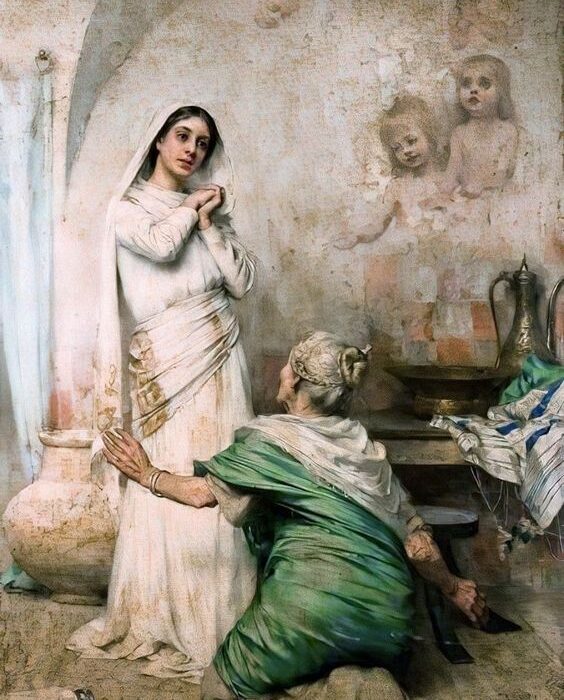
First Evensong of Advent
‘For Behold from this day, all generations will call me blessed.’ For
‘He has filled the hungry with good things, and the rich he has sent empty away.’
+INJ+
All generations shall call the Virgin Mary blessed, it perhaps even seems commanded in the Bible by the song of Mary, the Magnificat, itself. And for good reason, for perhaps she alone since Moses rightly deserves to be called a theologian.
In the years of her innocence, as a girl likely no older than thirteen or fourteen, by God’s grace, she had discerned the nature of her Lord where all others chased shadows.
What the apostles did not understand after many lectures and admonishments from the lips of Christ, what they only began to comprehend by the light of our Lord’s death and crucifixion, what they saw clearly only in the radiance of the resurrection; here holy Mary saw clearly as little more than a child.
And what is this that the Mother of our Lord has understood? She understood the first lesson of the Law of Moses: that in the beginning God made all things out of nothing.
You see, it was not the way of our Lord to create all things from some pre-existent matter, as a carpenter might make a table out of good wood. He would create free from any such matter, He would create by His Holy Spirit through the Word, who is the Son, in the void, in the complete and utter nothingness that yawned infinitely wide at the commencement of time.
It is written, ‘The world was formless and void.’ Just as a painter paints only upon a blank canvas. Now God accomplishes His masterpiece upon the blankness before Him; He creates time and space, and all that populates every corner of the universe, age upon age. He drew the world upon a world that did not yet exist, formless and void.
Yet this way of our God is not restricted to the creation of the universe, but extends to all things. For all worlds and stars and light and life were founded in the stability of the eternal word of God, called into existence by God’s unchanging utterance. God commanded, and it was. God spoke, and it happened.
But with man, it was not so. God did something different. He was not merely called into existence, or commanded to sprout from the earth like the plants, or out of the sea like the birds.
Rather, he was formed of the dust of the ground, watered, by the mist which rose up from the land, which is to say, man was made of dust and water, made of clay.
Clay is something to be molded, to be handled and formed as the workman, the Potter, sees fit. We say that children are as clay in the hands of their parents. I think most parents might disagree. But it is a truth of our faith that man is, literally, as clay in the hands of God.
Man was created in a different way, to become whatever it is that God intends him to be. He is made alive by God’s breath, and formed by God’s hand: filled with God, and surrounded by God, though man be nothing, nothing but dust and ash.
It is the way of God to create from nothing, and to work with what is nothing but dust and ash.
Recall that it was from the slavish rabble of Egypt, the ‘children of Abraham’ that God raised up His Holy People, that through them all nations would find salvation; and it could not be otherwise; “It was not because you were more in number than any other people that the Lord set his love on you and chose you, for you were the fewest of all peoples, but it is because the Lord set his love on you and is keeping the oath he swore to your fathers, that the Lord has brought you out with a mighty hand and redeemed you from the house of slavery, from the hand of Pharaoh king of Egypt.”
For what use has God with mighty Egypt? Let Egypt rise and fall by its own strength; but let lowly Israel, who has no strength of his own, be given all the power of God.
Countless other examples could be given from the Holy Scripture; but to one who’s eyes are purified by faith from conceit, one thing is obvious: our God is in the habit of creating out of nothing; and in fact He accomplishes nothing unless nothing is first given Him in which to accomplish something.
It cannot be but as it is written: “Blessed are the poor, for they shall receive the kingdom of heaven.” “Blessed are they who hunger and thirst, for they shall be filled.”
‘Blessed are those who have nothing of themselves, that they might be given everything from God.’
So Mary is greeted by an angel: ‘“Greetings, O favored one, the Lord is with you!” And yet Mary is troubled by the saying, and tried to discern what sort of greeting this might be.’
We, who are of a wicked mind, would not question this greeting. We would eagerly respond, “Why, God sent me an angel! Of course! You’re looking rather radiant this morning.”
And yet Mary does not know who this angel is. She tries to ‘discern what sort of greeting this might be.’
The angel continues: “Do not be afraid Mary, for you have found favor with God. And, behold, you will conceive in your womb and bear a son, and you shall call his name Jesus. He will be great and will be called the Son of the Most High.”
But Mary still asks: “How will this be, since I am a virgin?” Does she doubt? No, she does not doubt at all; perhaps she alone believes in God.
A spirit comes to her, promising that her son will be son of David, the king of Israel, of the everlasting house of God. But she knows her God, and she knows herself. “How will this be, since I am but a virgin? I am nothing, and nothing of good can come from me.”
The angel answers: “The Holy Spirit will come upon you, and the power of the Most High will overshadow you.”
Now her fear is stilled; now she knows she hears from God. “Behold, I am the servant of the Lord; let it be to me according to your word.” It is as if she had said, “Yes, my God, I recognize your voice now, for not by any merit of my own, nor by the power of any man will this great thing happen, but from the humility and formlessness of my being and within the void of my womb will you create my redeemer by Your Holy Spirit, as You did long ago, in the beginning of all things.
Create by Your Word within the emptiness of my being, even as You created by Your Word in the emptiness of the expanse of creation. And form my Savior and Your Son from the clay of my flesh, that He might not be just a man, but that He might be made man, even all mankind.”
Now let all generations call this little girl blessed; not because of any worthiness in her, not because she was pure or sinless or particularly faithful, but because she was utterly empty, having no merit of her own, having not even faith of her own. But she was empty, formless, and void.
Her faith was conceived within her virgin soul by the word of the heavenly Gabriel. For this reason she sings: “You have filled the hungry with good things.”
Let her name everywhere be blessed; even as in her exaltation, the name of all the proud are forever cursed. For those Sadducees who sought holiness through rites and rituals of their own careful devising are now derided, and the pride of the Pharisees who believed that by keeping the law rigorously they might be made worthy of God’s love are ‘scattered in the imagination of their hearts.’
Now, today, we see that all great empires come to an end, and all the ambitions of men have their time, and disappear.
But even as the rich man lies tortured, looking across a chasm at Lazarus who is consoled by the embrace of Abraham, so now all the prideful and arrogant people of the world, countless intellectuals and politicians and ethicists, look across the chasm at the lowly virgin with downcast face, consoled by the extended arms of her Son who is now forever praised as blessed; for she was nothing, and for this very reason, she “found favor with God.”
But what of us? The season of Advent is a penitential season. In the past, it was marked by fasts and agonizing vigils. And all this for the purpose of bringing people to realize that they, too, are nothing, that they are but dust before the glory of God. A little weakness from lack of food, a little frailty from lack of sleep; now do you realize that all your pretense to wealth and success and power is meaningless? That a few missed meals and a bad night’s sleep can bring you to nothing?
Do not avoid such seemingly depressing thoughts; embrace them, and know that you are nothing. Embrace the low self-esteem, even against the advice of a therapist.
Repent of your self-love, your pride. Empty yourself of conceit, that the Son of God may be conceived and born within you, and fill the emptiness of your humanity with the fullness of the divine nature, transforming you into a child of God, “born not of blood, nor of the will of the flesh, nor of the will of man, but of God.”
Do not praise Mary with vain words and titles as some do. Honor her by imitation, knowing that you are nothing, that you might receive within yourself the Lord, who is everything.
And when you find such imitation, such self-emptying, such repentance, impossible, remember the words of the angel: “Nothing will be impossible with God.” That purification which you cannot even in grace fulfill in this life, God will fulfill through age and sickness, through weakness and death; through all those things which your pride despises, through the cross laid upon your mortal frame.
And then, when your soul sighs and groans, when it grumbles to the Lord of all, saying “You have indeed cast me from my throne, and scattered me in my heart, will you exalt me in my humble estate?”
When you say with the Psalmist: “I am a worm, and not a man, scorned by mankind and despised by the people.” “I am poured out like water,” “and my bones pierced in the night,” “my strength is dried up like a potsherd; you lay me in the dust of death.”
Then lay down, even if on your deathbed. Suffer, hooked up to so many machines in some sterile hospital room, strung along a little longer by doctors and nurses. What your effort all your life has failed to do, the cross of dying will accomplish in you. “Do not be afraid.” Close your eyes for the last time. God will in love rebuke your words of lament: “You say you are but dust? But ash? That your entire life is vanity? Now you see that you are less than the lowliest slave? You have answered well;
But truly, I say unto thee:
“Thou art my son, this day have I begotten thee.”
+INJ+
Preached by Pastor Fields