
Sermon for the Last Sunday of the Church Year
‘Blessed are the barren and the wombs that never bore and the breasts that never nursed.’
+INJ+
Blessed indeed. Who would bring a child into this world.
I do not mean to speak of this time or this period or any particular child. Neither does the Lord. I do not wish to say that we live in some peculiar moment where having a child is a miserable thing. Neither does the Lord. For in the Garden, the Lord already spoke: ‘In pain shall you bear children.’
Many simply think this refers to labor, which, from what I gather, is painful. But this pain is but a symbol of the true suffering of giving birth; that you give birth to a child, a child shackled by sin, a child that will one day die.
[The Scripture is clear, when it says, ‘I will greatly multiply your pain in childbearing,’ it is not a reference to the carrying or delivery of the child, but, according to the Hebrew, the conception. For even in that happy moment, when a woman discovers she is no longer a woman, but an expectant mother, and a man no longer a man but a proud father, their pain is greatly multiplied, for what they have conceived is but a life lost, or a death, like their own, but one more time.]
This is the pain.
[The man too is cursed, even the proud father, for by the sweat of his brow, he shall eat bread, until he returns to the earth. If the life he has just conceived is to not die immediately, if it is to live, he must toil, and work the soil, and bring up living things, food, to feed it, that by the loss of the life of plants and animals, the life of his wife and little ones might be strung along a little longer. A little longer, I say, for God then adds, dust thou art, and to the dust thou shalt return.]
It is the curse of man that he shall work all the days of his life just to feed a family, so they do not starve and pass away. It is the curse of woman that she shall labor all of her days to bring forth and raise that which will pass away, that is, her children.
For it is written: ‘You shall surely die.’
No one wishes to see their child die, and most will not; rather, their children will watch them die. This is no comforting thing. For a child mourns for their parents as much as a parent mourns for their child. This is the world of things that pass, of things that die; where one thing overcomes another; where one thing prevails upon another; this is the world we chose.
Therefore, the God whom we betrayed in the garden does not say anything dark and controversial. He only repeats the logical wisdom of the fate which we brought upon ourselves in our Original Sin: ‘Blessed are the barren.’
In our reading, Our Lord Jesus is crucified, the death of traitors, and indeed our Lord is a traitor, for being made man He is a traitor to this world made by men. He is a stranger in the hell we made, and because He did not call our hell a heaven, we put Him to death.
A man crucified with Him cries out, ‘Are you not the Christ? Save yourself and us!’ Perhaps this man was being sarcastic, an ancient trait of angry men. But is this not the prayer of the Church? What does Lord have mercy mean but ‘save yourself and us?’ For indeed the Lord will be saved by His resurrection, and the path of salvation is laid down for us in His Ascension.
Yet another sinner cries out: ‘Jesus, remember me in your kingdom.’
Though these seem to be portrayed as contradicting one another, one is just the answer to the last. ‘Save us.’ ‘Remember us.’
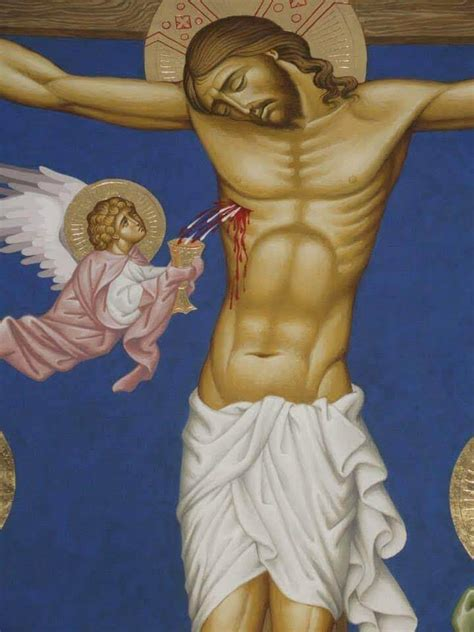
We speak of the crucifixion, a day of violence and of gore; of blood, and of water. These things the Lord shed, having been made flesh for us, that we might be saved, that we might be remembered.
We often say in Church that you should cross yourself to remember your baptism. Yet we should know that in our remembering our baptism, God first remembers us, even as He remembers His promise to not wipe out all life upon the earth when seeing the rainbow He set in the clouds after the Great Flood. God remembers His promises.
A mortal child is born, and at the moment of his birth he is destined to die. This is the fate of all men. And because of this, all women ‘bear children in pain,’ and the Lord says, ‘blessed are the breasts that never nursed.’
Yet, the Lord bleeds, the Lord suffers. The Christ is on the cross. And His side is pierced by a lance. Blood and water flow from the wound. Blood for the chalice; water for the font. Christ says many things. Did He not also say ‘I make all things new’?
What is born mortal is made immortal. What is born frail is made invincible. And all this, by the water, and by the blood of the God who became man, that we might become God.
As the water is poured upon a wretched sinner, the Lord says only, ‘This shall be mine, on the day when I take up my treasured possession.’
And on the day of death, what shall that water speak?
‘Today, you will be with me in paradise.’
+INJ+
Preached by Pastor Fields
Sermon Texts: Malachi 3:13-18; Colossians 1:13-20; Luke 23:27-43.