
Sermon for the Feast of the Reformation
‘Come, behold the works of the Lord,
how he has brought desolations on the earth.’
+INJ+
It has become increasingly commonplace among Christians in these recent times to mourn the disunity of the Church, and rightfully so, for the Apostle Paul exhorts us, ‘that ye all agree with one another, that there might be no division among you, but that you be completely united in mind,’ ‘making joy complete, by being of like mind, one in spirit and in thought.’ To fulfill the prayer of Christ, that we might be brought to complete ‘unity, I in them, and you in me, that the world will know you have sent me, and have loved them even as you loved me.’ For it is written, ‘how pleasing it is when brethren dwell together in unity.’ So highly prized was this oneness of heart, that St. Luke describes the Church as ‘being of one accord in mind and in soul.’
The disintegration of the Church, its fracturing, its dissolution into so many tribes and factions and schools and theologies is indeed to be mourned; and only more so in this country, where all of them must live side by side, and so compete one with another for the same lot of Christian souls.
The warring over the jurisdiction of souls by the so-called ‘denominations’ is disgusting, and a putrid vomit before the Lord, who scatters the proud in the imagination of their hearts, and yet we war, we battle to gain more souls for our sanctuaries against those of the heretics, for, on our best days, we do not want weary Christians or even interested pagans to fall into the hands of false-teachers, or, on our worst days, we fear that if we do not gain membership at the expense of others, the future of our congregation, our churches, our communion cannot be guaranteed.
For this reason, many churches preach that they are ‘the one, true church,’ set apart from the many battling sects of America. Such a claim the Papal Church has made since the Middle Ages, as does their Greek speaking battered ex-wife in the East. So too it can be heard among many of us, who belong to the Evangelical Lutheran church. We all speak greatly of the unity of the Church, while accusing all others of introducing the divisions we hate.
More often we seek to claim the mantle of this ‘one, true church,’ not out of love for the unity we claim to have in Christ, but because we know the appeal such a claim makes to those who are broken and haggard by the anxiety of having to ‘choose the right church’ when there are so many to choose from. We promise them that if they choose our church, then they will never have to question their religious affiliation ever again, because it will be ever so clear that they have chosen correctly.
To those who rightly lament the fragmentation of the Christ’s Church, they see the Reformation as the defining moment of the Church’s collapse. Before the Reformation, it could be said that there were only a few churches divided against each other. The so-called Catholics in the West, the Orthodox in the East, perhaps the English up on their islands, and the Coptics who eat watermelons down by the Nile. Then came the Reformation, which saw not the rise of the Magisterial Evangelical Church that we call our own, but also the selecting Calvinists, the sacramentarians and Baptists, and Methodists and all the other various titles affixed to church signs across this lovely state.
It makes it a bit awkward to celebrate this day, when we keep these things in mind, we, who view Reformation Day as a sort of ecclesiastical birth-day.
Yet the Reformation did not create these divisions, but only recognized them, for dissensions have torn the Church from even before the birth of the Lord, even as he says, ‘the kingdom has suffered violence, and the violent take it by force.’ He warns us that ‘false messiahs and false prophets will appear and perform great signs and wonders to deceive, if possible, even the elect.’
Indeed, the whole corrupt body of blasphemy arising within the Church herself is symbolized by a beast arising out of the earth in the vision given to St. John, having the appearance of the Lamb, but speaking the words of the dragon.
The good monk Martin Luther summed up the problem simply: ‘Where God has built a church, the devil has built a chapel.’
For there never has been a time, and never will be, when the church is not torn apart by disagreement and heresy and schism, for to believe that such things were not before, or will not be soon, is to deny the assaults of Satan upon the Virgin Mother, or to deny the adultery of man’s heart against the Bride.
It is because of our sin, it is because of the devil’s intrigue, that desolations are wrought upon the earth, for we, who are violent, desire to possess the Church as our own, and we take it by force.
But the Church cannot be divided, it cannot be torn, it cannot be shattered, for the Church is nothing other than the Body of Christ.
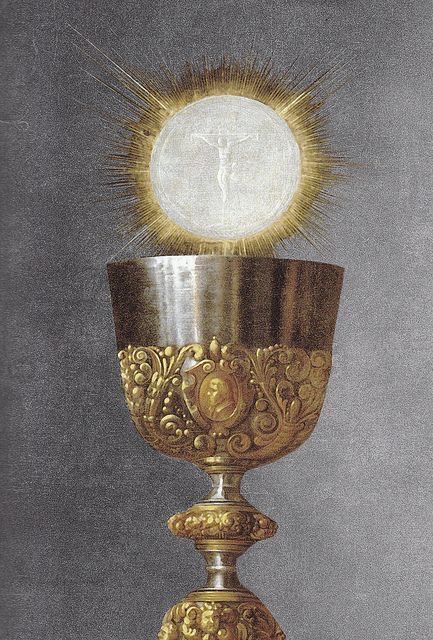
By this, I do not mean the metaphorical body of Christ, the net sum of all Christian believers. I mean that the Church is Christ’s very body and blood, which was born of the Blessed Virgin Mary, and suffered and died for us on the life-giving tree; the blood that pleaded from the dust for mercy upon wood, the very flesh that was committed to hell. This flesh, which penetrating into the mouth of Hell, by the sword of the cross broke the teeth of Sheol and death, that being found to be most pleasing before the manifold eyes of the Father, it might be brought up from the grave, and welcomed home in the Heaven of Paradise, in the Garden, which is the Father’s radiance.
That body, which walked the ways of Galilee and entered into Jerusalem, the Holy City. That blood which dripped down the wood, ‘as the gentle rain from heaven, twice blessed,’ that flesh, in that one Man, who is the One God, is the Church, and He is never divided, for he cannot deny himself.
That body we call ‘the Bride of Christ,’ for it is wedded to the eternal Son, being made one flesh, in the Incarnation of the Word.
We, who call ourselves Christians and the Church, are only so because we come here this and every Lord’s Day, now and forevermore, to unite ourselves to the One Divine Body, to eat of the Heavenly Supper, and so receive sinlessness from the one sinless Man. It is proper that we colloquially refer to our presence at the Divine Liturgy, as ‘going to Church.’ We are indeed going to the Church, for we are going to the incarnate Son of God, who here dwells among us, rich in mercy and forgiveness, even if all fall away from the faith, save that two or three are yet gathered in His name.
The world sought to tear apart the flesh of Christ on Good Friday with so many floggings, and to punish it with nails and mockery, ‘yet not one of his bones were broken.’ So too now does the world seek to divide apart the Church, and yet she will not be divided.
For the Church is not unified by allegiance to an earthly institution, nor to a Pope, nor to a supposed unaltered practice or tradition. It is unified alone by the victorious flesh of Jesus, which have overcome the world. It is unified by the cry of victory that rings out across the battlefield in the wilderness, of the cross raised upon the corpses of the demonic legion. It is unified by the eternal Gospel, proclaimed to those who dwell on earth.
That there is one hope, one faith, one Baptism, one God and Father of all, who is above all, and through all, and in you all, even as He enters into you now and forevermore, from this altar.
The disunity of the Church is an illusion, another lie of the devil, which seeks to deceive our senses through an appeal to our eyes, even as Adam was deceived by the beauty of Eve, and Eve by the beauty of the fruit of the tree. For the fruit of the virgin Mary is One Man, a Second Adam, who Himself now and forevermore is our Tree of Life, of which we are but many vines and many branches.
This, then, is the Reformation, the proclamation against all deceptions and heretics and so-called wise men that the victory of one Christ against sin, against death, against the devil, and against the whole mass of unbelief is total, complete and glorious; fully accomplished and ever presented in the oneness of His flesh, where forgiveness, life, and salvation are given, for in Him there is no darkness at all, for He is the light, which is the life of the world, the only begotten of the Father, full of grace and truth, our Immanuel, for he will save His people from their sins.
In former times, the children played the flute, and we would not dance, they would sing a dirge, and we would not mourn. For we knew neither joy, nor would we repent. But in our ‘Lord and Master Jesus Christ, all our life is one of repentance,’(1) and so we mourn our sin, and all our life is an endless song of praise for the forgiveness here offered, and so we dance.
Even dancing into the gate of heaven, ‘through many tribulations and trials, and not the false security of peace.’(2)
For wisdom has been forever manifested among us in the Gospel of the Son,
And she is justified by his deeds.
+INJ+
(1.) This is a quotation from the First of Luther’s 95 Theses.
(2.) This is a quotation from the Last of Luther’s 95 Theses.
Preached by Pastor Fields
Sermon Texts: Revelation 14:6-7; Psalm 46; Romans 3:19-28; Matthew 11 :12-19.