
Sermon for the Feast of St. Michael & All Angels
‘Lord, even the demons submit to us in your name.’
+INJ+
It is the Feast of St. Michael, a holy one of God, an angel, and one of only two angels ever called by name in the Scriptures.
His name is peculiar, for it is a question. ‘Mi-chi-el,’ it simply means ‘who is like God?’
A good secularist today would answer, well, any other supposed ‘god,’ since to him all gods are alike, they are all figments of the imagination, unreal, and therefore unimportant. As a certain famous atheist once quipped: ‘all Christians are atheists when it comes to every god but one. I am just an atheist about precisely one more.’ But that is not strictly true, for Christians do not deny the power of the ‘gods.’
I once wanted to write a book about the gods. A book explaining the spirits of the world in the exact way it would have been understood by those who in former times professed belief in them.
It is somewhat difficult for us now to understand the nature of ancient paganism. They believed in vast pantheons and families of divine beings, all consorting with each other, begetting each other, killing each other, raging with each other, falling for each other, eating each other. Their religion seems like little else than a panic-induced fever dream rendered into a cult, especially compared to the realistic earthiness of the Scriptures, and the logic and philosophical rigor with which the Bible’s vision is explained and defended by the contemplation of the Church.
Yet the nature of this paganism, of these gods, becomes muddied by their peculiar, and, at least to us, somewhat fanciful and arcane names, Ares and Chronos and Venus and Vesta and Psyche and little cherubic Cupid.
But to the old pagans, these names were not really names at all, at least not how we use names. They were simply words. Ares, who we think of as the god of war, is simply the Greek word for ‘strife.’ Chronos, the father of the Gods, is simply Greek for ‘time,’ as in the word ‘chronology.’ Venus simply means ‘love,’ in Latin, and Vesta means ‘home.’ Pysche means ‘soul.’ Cupid, the little chubby child with a penchant for archery, means ‘pleasure.’ He carries his bow because of its shape, since it looks like a pair of lips, all the better to kiss you with.
Once we understand this, the old myths don’t seem quite so silly at all. Chronos devours his own children, because time ultimately devours all. Venus paying Cupid to cause Psyche to fall in love with a wild boar is the story of how love and pleasure can convince the soul to debase itself into worshipping what is stupid and unthinking.
But this is not to say that, to the pagans, the gods were just metaphors, or colorful ways of describing life. They believed these gods were real, because they recognized that the forces that their names represented had real power. When we become angry, it is not usually the result of a long series of logical deductions wherein we reason that a certain person is justifiably deserving of our bad manners. We just ‘get mad.’ We are taken by a sudden demand for immediate justice. It is almost as if we are possessed by something that we cannot control. Something stronger than us. Something like a god, and god named ‘strife,’ a god named Ares.
So can it be said when we fall in love, or when we were all overtaken with a feeling of patriotism after 9/11, that Venus has turned our heart, or Vesta has awakened in us a love of our home.
And when we become old, and only daily older, we only begin to understand the reality of Chronos, that he does, indeed, devour all.
Of course the pagans worshipped these ‘gods,’ not because they would gain any benefit from them, but because they were, indeed, worthy of worship; they indeed have power over us, and we are helpless against them.
Quite contrary to what the secularist wants to think of himself, he is actually entirely wrong. The gods, so understood, are not a figment of our imagination; they are real, and they are so important that they govern every aspect of what he calls his ‘life.’ The fact is that, apart from being an atheist, he in fact worships every god of the Pantheon – justice and sex and pleasure – and only denies the existence of one: the God of Israel. Just like his pagan ancestors.
It is concerning these gods that St. Paul writes: ‘For although there may be so-called gods in heaven or on earth—as indeed there are many gods and many lords— yet for us there is one God, the Father, from whom are all things and for whom we exist, and one Lord, Jesus Christ, through whom are all things and through whom we exist.’ One Lord, One God, the One the secularist alone denies.
It is these gods that the early Church recognized as demons, and very real ones; it is these demons that the Medieval Church renamed as the ‘Deadly Sins,’ and very real ones.
It is to these, the sins in our souls, and the demons which stir them up, and the gods that they represent; ‘the elemental spirits of the world,’ ‘the powers of the air,’ ‘to whom you were once in bondage,’ it is to these that the archangel Michael asks, ‘Who is like God?’
The answer, it would seem, is obvious. For it is written, ‘there is none like you among the gods, O Lord, nor any works like unto yours.’ ‘There is no one holy like the Lord,’ for ‘beside him, there is no other.’ Indeed, God Himself declares, ‘I am God, and there is none other; I am God, and to me are none alike.’
Indeed, there is none like God, nor could there be, for He was when everything was naught, for through him all things exist. All that exists, exists merely by His will. He alone is that which is. To what, then, can He be compared, who is beyond all things that exist against which He would be likened? What exists to which He might be measured, He who is the Measurer?
There is a reason that our God is a jealous God, for nothing of Him can be lent out or borrowed, nor can it be given or created. What He is, He is alone. And there is no other.
Nothing of Him can be given or created or lent or borrowed. Yet our God, though forever one, is yet never alone. There is one like him, and St. Michael’s question is answered: begotten, not made, God of God, light of light, very God of very God.
Who is like God? It is the Lord Jesus Christ. Who is like God? It is God, who has become man. Who is like God? It is our humanity, who has been assumed into the divinity. Who is like God? It is Adam, who in Christ, is now in the likeness of God.
Now God has entered into His image, and taken the form of a servant; a jealous God, that He might regain that which the so-called gods have claimed as their own.
They once believed themselves to rule over us, and we even once thought that in the futility of our minds. For so long we lived under their oppression, of the demons, which we once called gods, of sin, which we once called worship, and of death, which we once called ‘time.’
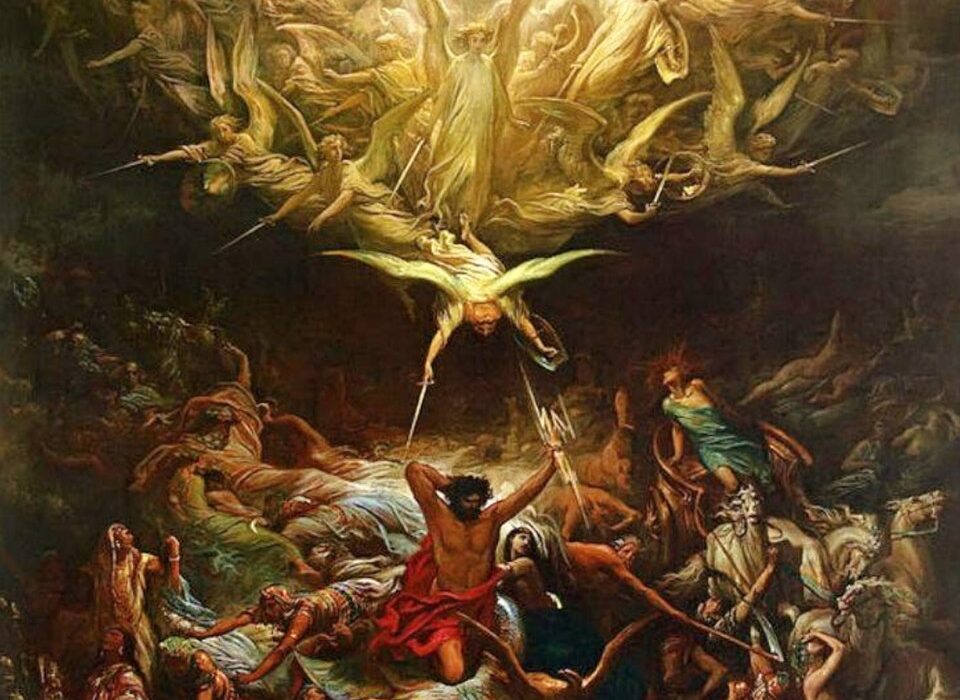
But now our King, Him whom we had long forgotten, or perhaps had lost hope in; that King has returned, armed and guarded by so great a legion of His Holy Ones, His angels, burning in light and covered in eyes, pouring forth incense from their hearts and eternal praise from their lips.
This day, we join in their song, and follow in their train as St. Michael looks upon him who was cast down as lightning from heaven, and those who submit to the Name, even as he again asks before their terrified faces, as an interrogator to a traitor, ‘who is like God?’
‘For the accuser of our brothers, who accuses them before God day and night, has been cast down.’
Let us then join in this dread army, O Church of the Father, and bear up our weapons, O Elect of the King, that with all the breath within us, we might daily mortify this body of sin, this high place of Ba’al, which the devil has built within our hearts, that we might join in the Crusade of St. Michael and all the angels, to abolish the last enemy, which is death.
Indeed, even now, the devil is filled with fury. Of course he is, dear companion of the angel-terror.
‘For his time is short.’
+INJ+
Preached by Pastor Fields
Sermon Texts: Daniel 10:10-14, 12:1-3; Revelation 12:7-12; Luke 10:17-20.