
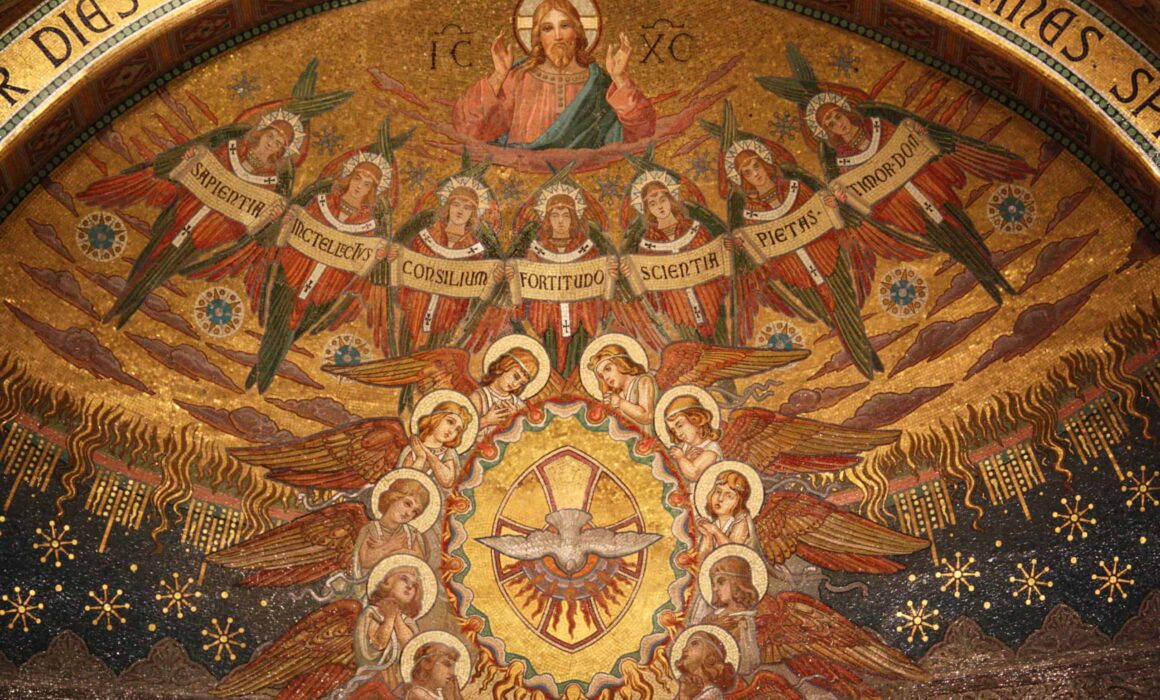
The Spirit of Christ: The Third Person of the Trinity
As we enter into the season of Pentecost, we are brought to remind ourselves of the work of the third person of the Trinity, the Holy Spirit.
But, if we are honest with ourselves, sometimes we are not entirely sure what the work of the Holy Spirit is.
In most of American Christianity, the Holy Spirit is viewed as a sort of force or substance that can be ‘poured out’ and ‘fill us,’ that can ‘guide us’ and ‘be powerful’ in our lives. It is viewed as something that can be measured, that one can have ‘more’ or ‘less’ of.
Then we hear of our Charismatic and Pentecostal friends who tell us how the Spirit even today gives us power to perform miracles of healing and speaking in tongues, or even of prophesying in the modern world. It is a bombastic thing, something that does the unbelievable.
But this is contradictory to the Trinitarian faith, not in that the Spirit isn’t powerful nor miraculous, but in that the Spirit is not a thing. The Spirit is a person.
We rarely think of the Holy Spirit as a person, and it is easy to see why. The Father is easy to imagine as a person because, well, He is like a father. The Son, likewise, is easy to see as a person, since He is a son. But the Spirit? What is a Spirit? An invisible, evanescent, windy thing, it would seem.
Even our artwork doesn’t encourage us to see the Spirit as a person. In paintings, very often Christ is depicted as a man holding up His hand in the sign of blessing, with the Father next to Him depicted as an old man with a beard. Meanwhile, if the Holy Spirit makes an appearance in our art at all, He is depicted as a dove, or a ray of light, neither of which are things we are used to viewing as persons.
So why does the Church view the Spirit as a person when it seems so unintuitive?
The answer is simple: it is because the Holy Spirit is described in the Scriptures as being a person, and having its origin in a person, particularly in Jesus Christ.
Though the Spirit did appear to Jesus and John at the Baptism of Our Lord as a dove, and floating above the heads of the Apostles as tongues of fire, yet when He is actually described by the Bible, He is shown to be a person. He is called the paraklete, a Greek word for one who would make a defense of a client during a legal hearing, something much like a modern attorney or advocate.
Similarly, Acts 5 calls Him a martys, or ‘witness’ testifying to the truth of Christ.
But most importantly, He is described as the Spirt of Jesus Christ, and of the Father, Himself; as another ‘Comforter’ along and beside them, equal to them. He is the bond of love of the persons of the Trinity, which bears witness to them for the Christian, and advocates for the Christian to the Father in heaven. As He is the Spirit of the Persons of the Father and the Son, He Himself is thus a Person.
It is in this Spirit that the Lord Jesus is indeed with us always, until the end of the age, for he will send the paraklete, to guide us into all truth. The Spirit of Christ is the presence of the person of Christ; that is, He is the very personality of Christ with us.
For this reason, we pray to the Holy Spirit, just as we would pray to Christ, knowing that He hears us, and answers us, for as long as the Spirit is with us, guides us, teaches us, and enlightens us, so Christ is doing for us and among us forevermore.