
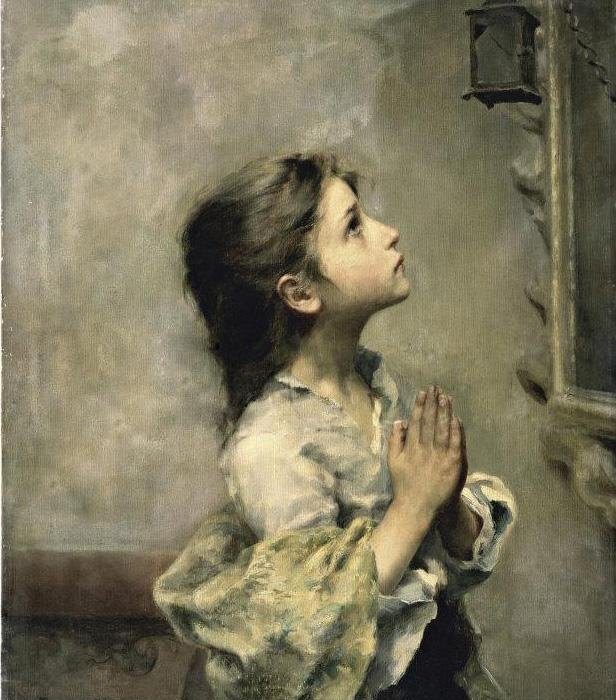
Sermon for the Sixth Sunday of Easter
‘Truly, truly, I say to you, whatever you ask of the Father in my name, he will give it to you.’
+INJ+
To pray is perhaps the most misunderstood, or perhaps most cruelly tortured practice in all of Christianity. We know that through the priesthood of Christ, we are given access to the heavenly Father, to bring to Him any and every concern and longing of our hearts. Yet we are children, at least children in faith, that the longings of our hearts are not the desires of the Father.
We ask for innumerable things, believing that by our mere asking, God has some obligation to grant our wish. Some would call Him a divine vending machine, but we don’t even consider Him that, because vending machines at least demand payment, and usually a payment far beyond the market rate of the object we desire.
We are generally unwilling to pay anything. We just want, and expect to be able to take what we want. Far from viewing God as a vending machine, we treat Him more like an abandoned house that we can sneak into and plunder, hoping to get away with whatever goods seem to be available, willfully ignorant of the fact that most abandoned houses are still, on paper, owned by someone, along with the property therein. But this kind of theft seems innocent, because what loss is it to the owner, who obviously does not care much for his possessions? God possesses everything. Surely He could spare us a little of His excess. It is not like He would miss it.
But if we pray to God, asking for this or that, and do not receive, we become angry; we feel that an injustice has been done. Why should we not? So does the thief breaking into the house when he is caught and told that he can’t just steal what he wants; even steal that which seems unwanted by the owner.
We do tend to think of God as an abandoned house that is only worth discovering if something we want might be found in it. But when He does not give us what we want, we walk away, and never think of Him or seek Him out again.
The internet is a dark and depressing place. Never go on it.
But if you do, you might come across certain forums run by ex-Christians discussing their journey from infantile religiosity to nihilistic godlessness. Most seem to argue that this transformation was a good thing, right before they begin arguing that life is not worth living.
Disregarding the advice that I just gave, I often go on the internet to read through just such gloomy forums as these, and one thing that strikes me is the absolute magnitude of people with almost exactly the same story: they used to believe in God, they used to go to church, then someone in their family became sick. They prayed for the person to be healed, and it didn’t happen. Then they stopped believing in God, since the only reason their prayer wasn’t answered in the manner they wanted was either because He didn’t exist, or because He wasn’t particularly kind.
I have never understood why people refuse to believe in God because they find Him not nice. To me it would seem that that would be all the more reason to believe in Him and do as He asks. One’s boss is rarely viewed as being particularly charitable and open-hearted, but that is not a good reason to listen to him less; and I dare not begin to speak of in-laws.
But the argument that God must not exist because He does not do what we want, is to view God as being less than God; as being less than the vending machine; perhaps being even less than the abandoned house, since one rarely punishes the house for not having what one wants by refusing to acknowledge that the house ever existed.
It does not matter whether what we demand in our prayers seems reasonable, or even good, according to our sensibilities. The fact remains that God is higher than a vending machine in the order of things. He has no obligation to give us anything, even if we pay with interest.
But now our Lord speaks to us something different: ‘whatever you ask in my Father’s name, he will give you.’
He seems to teach us the exact opposite of what we have just spoken about. Whatever we ask in His name, He will give us!
Yet in the same way that to take the Lord’s name in vain is not to utter the phrase ‘O my God!’, to ask in the name of God is not merely to end our demands with the utterance of the words ‘In Jesus’ name.’ To invoke magical formulas believing that they bind God to our will is the definition of sorcery, which if one remembers their Catechism, is forbidden in the Second Commandment, the one that tells us not to take the Lord’s name in vain.
If we are to understand what our Lord is saying, we must know what it means to ask in the Father’s name, and it is not difficult. When we ask for something in the name of our friend, it means we ask on his behalf, we ask for what he would ask. When the servant of Isaac seeks a wife for his master in Isaac’s name, he asks as a representative of Isaac himself. So if we ask in the name of the Father, it means to ask as the Father Himself. To put it simply, and in the way we do not want to believe, it means to ask only for what the Father Himself desires.
It is for this reason that the Lord properly prays in the name of the Father when He speaks the words ‘not my will, but Thy will be done.’ It is what it properly means when the Danish Lutheran Kierkegaard claimed that ‘prayer does not change the will of God, but conforms our will to His own.’ And it is why our Lord rightly says that the disciples have never asked anything in His name, for they had not asked for what the Lord Christ has asked, for what the Father wills to give. And likely, O Church, neither have we.
How then, shall we pray rightly? For what then, should we pray?
We are deceived if we think that we may pray for anything more than what our Lord has prayed, for a student is not above his master. And what has the Lord prayed for? ‘Father, glorify me.’ ‘Yet when he spoke of his glorification, he spoke of the hour of his death.’ ‘For I desire those whom you have given me to be where I am.’ ‘And in this he told by what manner he would die.’ ‘Therefore take up your cross, and follow me.’
Is this not what the Father has promised? What the Son has taught? That you will be reviled and persecuted and have all evil said against you? That you too, should die a death like his, that you may be joined to a resurrection like his?
Is it not the case that what we should pray for is to be joined to Christ, and if we are joined to Christ, to be joined to His Passion, His death, His glory? Surely we confessed this when we received the Sacrament of Baptism; now will we walk away, since it seems too unpleasant?
Indeed we may, along with Christ, pray that this cup may pass from us, even as we pray for all who suffer; but shall we not also pray not my will, but Thy will be done?
It therefore makes sense why the Lord would teach us how to pray for our suffering when He Himself is soon to suffer.
Yet this He teaches us, saying that in it, our joy may be full. It seems a contradiction, but only to a carnal and sinful mind. For joy simply means to come to the fulfillment of something, and there is no greater fulfillment of our humanity than for our humanity to ascend to the Father. Even as the Lord rejoices in His Passion, that by His death and resurrection, He might ascend to the right hand of God; so too we must find our joy, our completion, in our suffering, our death, and the victory given us by Christ over the grave. For in these things shall our human bodies join the Lord’s deified humanity, to dwell forevermore before the face of the Father.
It is for this reason that St. Paul tells us, ‘I rejoice in my sufferings for your sake, and in my flesh I am filling up what is lacking in Christ’s afflictions for the sake of his body,’ and again, ‘that we may become heirs of God and fellow heirs of Christ, provided that we suffer with him, that we may be glorified with him,’ and St. James, who writes, ‘count it all joy when you suffer trials of every kind.’
Indeed, it is written everywhere, to suffer, dear Christian, that your joy may be complete, for unless a seed fall into the ground and die, it remains alone.
This may seem a hard saying, and who can accept it? Who would willingly pray for God’s will, if God’s will is to endure every evil and hardship and temptation? Who would ask for something so absurd, so stupid, so foolish?
You know of one, it is the One of whom it is written: ‘I will destroy the wisdom of the wise, and will bring to nothing the understanding of the prudent.’ Who mocks our thoughts saying, ‘Where is the wise? where is the scribe? where is the disputer of this world? hath not God made foolish the wisdom of this world?’
The One Who humbled himself by becoming obedient, even to death upon the cross.
Do not be deceived. A student is not above his master. So He tells us, ‘In this world, you will have tribulation.’
But take heart, dear Christian, for the Lord leaves you with this word, this fact, the one and only true reality:
‘I have overcome the world.’
+INJ+
Preached by Pastor Fields
Sermon Texts: Acts 16:9-15; Revelation 21:9-14, 21-27; John 5:1-9.